About Huntsville Spray Foam Installation
Huntsville Spray Foam Installation provides spray foam insulation services for homes, commercial properties, attics, crawl spaces, metal buildings, pole barns, workshops, barndominiums, and new construction projects in Huntsville and surrounding North Alabama communities.
Open-cell and closed-cell spray polyurethane foam both have a place in a well-planned building envelope, and the right choice depends on the assembly, the way the space is used, and the performance you want. From conditioned attics and sealed crawl spaces to metal buildings, pole barns, workshops, and barndominiums, the focus is matching the product to the project rather than applying one solution everywhere. The company works with homeowners, builders, business owners, and specialty-building owners across Huntsville and the surrounding Tennessee Valley.
Request an Insulation Estimate
Tell us about your spray foam insulation project.
Spray Foam Insulation for Homes, Businesses & Specialty Buildings
The work spans a wide range of building types and assemblies. Each category below links to a dedicated service page with more detail. Project suitability and foam selection always depend on the building assembly, the use of the space, project goals, and product and application requirements — so the descriptions below describe where spray foam may be evaluated rather than a one-size-fits-all promise.
Residential Spray Foam
Whole-home envelope work for attics, crawl spaces, wall cavities, additions, and remodels where assemblies are accessible.
Learn moreCommercial Spray Foam
Insulation and air sealing for commercial buildings, shops, storage structures, and light industrial spaces where appropriate.
Learn moreAttic Spray Foam
Roofline and attic assemblies evaluated for air leakage, conditioned-attic concepts, and existing insulation considerations.
Learn moreCrawl Space Spray Foam
Foundation walls, rim joists, and subfloor assemblies where spray foam may help with air sealing and moisture management.
Learn moreMetal Building Spray Foam
Steel and metal wall and roof assemblies evaluated for temperature swings, air leakage, and condensation considerations.
Learn moreWorkshop Spray Foam
Detached shops and workspaces where insulation can make heating and cooling easier, separate from ventilation needs.
Learn morePole Barn Spray Foam
Post-frame buildings, equipment storage, and hobby buildings where conditioned use is planned.
Learn moreBarndominium Spray Foam
Post-frame or metal residential homes combining living space with metal skins and large rooflines.
Learn moreNew Construction Spray Foam
Pre-drywall planning and coordination for new homes, additions, and commercial builds.
Learn moreOpen Cell Spray Foam
Lower-density, high-expansion foam commonly evaluated for suitable interior framed applications.
Learn moreClosed Cell Spray Foam
Denser foam with higher R-value per inch, frequently considered for metal and specialty applications.
Learn moreA Practical Approach to Spray Foam Insulation in Huntsville
Spray foam performs only as well as the planning and installation behind it. The approach below describes how projects are generally thought through — without claiming inspections, certifications, or protocols that have not been verified.
Understand the target application — whether it is an attic roofline, crawl space, wall cavity, metal building, pole barn, workshop, barndominium, or new construction assembly.
Consider how the space is actually used, since a conditioned workshop and a storage building have very different performance goals.
Discuss open-cell versus closed-cell spray foam where the choice matters, rather than defaulting to one product for every assembly.
Review accessibility and construction stage, including whether framing is open, whether drywall is already installed, and how the crew will reach the work area.
Account for existing insulation where applicable, since older materials may need to be evaluated or removed before a new assembly is installed.
Talk through project objectives so the insulation approach lines up with comfort, moisture, and build-schedule goals.
Prepare the work area appropriately, protecting surfaces, equipment, and finishes before any foam is applied.
Apply spray polyurethane foam to the intended assembly and keep communication clear from the first conversation through project completion.
Actual preparation and installation requirements vary by property and project. The company does not perform engineering, code inspection, energy auditing, mold remediation, structural repairs, or moisture remediation unless later confirmed. When those needs arise, they are discussed openly so the right steps happen in the right order.
Why the Right Spray Foam Application Depends on the Building
Spray foam is not a single interchangeable product. Treating every assembly the same is how good materials end up in the wrong place. A few distinctions help explain why the application is project-specific.
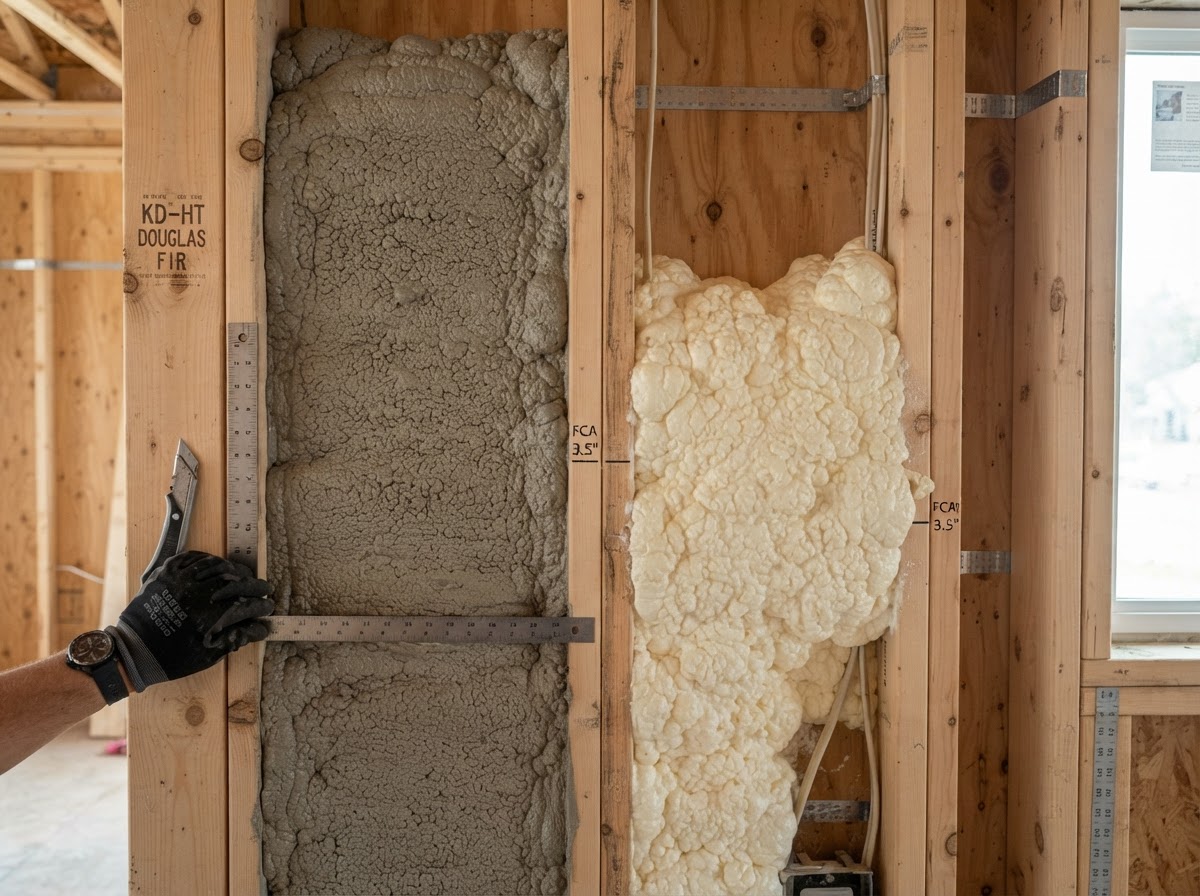
Open-cell and closed-cell spray foam are different products with different densities, expansion behavior, R-values, and vapor characteristics. One is not universally better than the other; the appropriate selection depends on the assembly, substrate, moisture strategy, and performance goals.
An attic roofline is not the same problem as a metal building envelope, and a crawl space is not the same as a workshop. Each assembly carries its own air-leakage paths, temperature swings, and moisture behavior. Condensation control, for example, depends on assembly design, indoor and outdoor conditions, foam selection, thickness, air leakage, and moisture sources — spray foam does not automatically eliminate condensation in every building.
Existing structures differ from new construction. Access, occupancy, existing insulation, and whether walls or ceilings are open all change what is possible and how the work is sequenced. Existing moisture problems may need separate correction before insulation is installed, and spray foam alone does not repair active water intrusion, drainage issues, or plumbing leaks.
Mechanical, electrical, plumbing, roofing, and interior-finish considerations can all affect project planning, especially in new builds and barndominiums where spray foam is timed around rough-ins and drywall. Product type and thickness should not be treated as one-size-fits-all; R-values are approximate and product-dependent, and the right thickness depends on the assembly and the target performance.
Serving Huntsville, North Alabama & Nearby Tennessee Valley Communities
Huntsville Spray Foam Installation is based in Huntsville, AL 35810 and serves residential, commercial, and specialty-building projects in Huntsville and surrounding communities. The business does not maintain branch offices in each city listed below; it serves those areas from its Huntsville service base. No specific travel radius or driving time is claimed.
Not sure whether your community is covered? Call to discuss your project location and we can confirm availability.
Call (256) 361-1406About Huntsville Spray Foam Installation: Frequently Asked Questions
Common questions about the company, the services offered, and how to start a project.
What types of spray foam insulation projects do you handle?
Do you provide both residential and commercial spray foam insulation?
Do you install both open-cell and closed-cell spray foam?
Do you work on metal buildings and workshops?
Do you provide attic and crawl-space spray foam insulation?
Do you serve communities outside Huntsville?
How do I know which spray foam is appropriate for my building?
How can I discuss my insulation project?
Discuss Your Spray Foam Insulation Project
Whether you are planning a residential attic, crawl space, metal building, pole barn, workshop, barndominium, new construction home, or commercial facility, reach out to talk through your building-envelope goals and request an estimate.