Commercial Spray Foam Insulation in Huntsville, AL
Commercial spray foam insulation applies spray polyurethane foam to the walls, roof decks, and steel framing of commercial and light-industrial buildings to provide insulation and air sealing in a single layer. For property owners and facility managers in Huntsville, Alabama, it can help stabilize interior conditions and reduce uncontrolled air movement across large building envelopes when the product and application match the structure.
Huntsville Spray Foam Installation works with commercial property owners, builders, and facility managers across Huntsville and the Tennessee Valley on warehouses, storage buildings, shops, retail and service spaces, and light-industrial structures. Commercial envelopes are large and exposed, so product selection, thickness, and condensation strategy all matter more than on a typical home. We evaluate the building's use, the assembly, and the interior environment before recommending an approach rather than applying a generic specification.
Request an Insulation Estimate
Tell us about your commercial spray foam insulation project.
What Commercial Spray Foam Is and Who It Is For
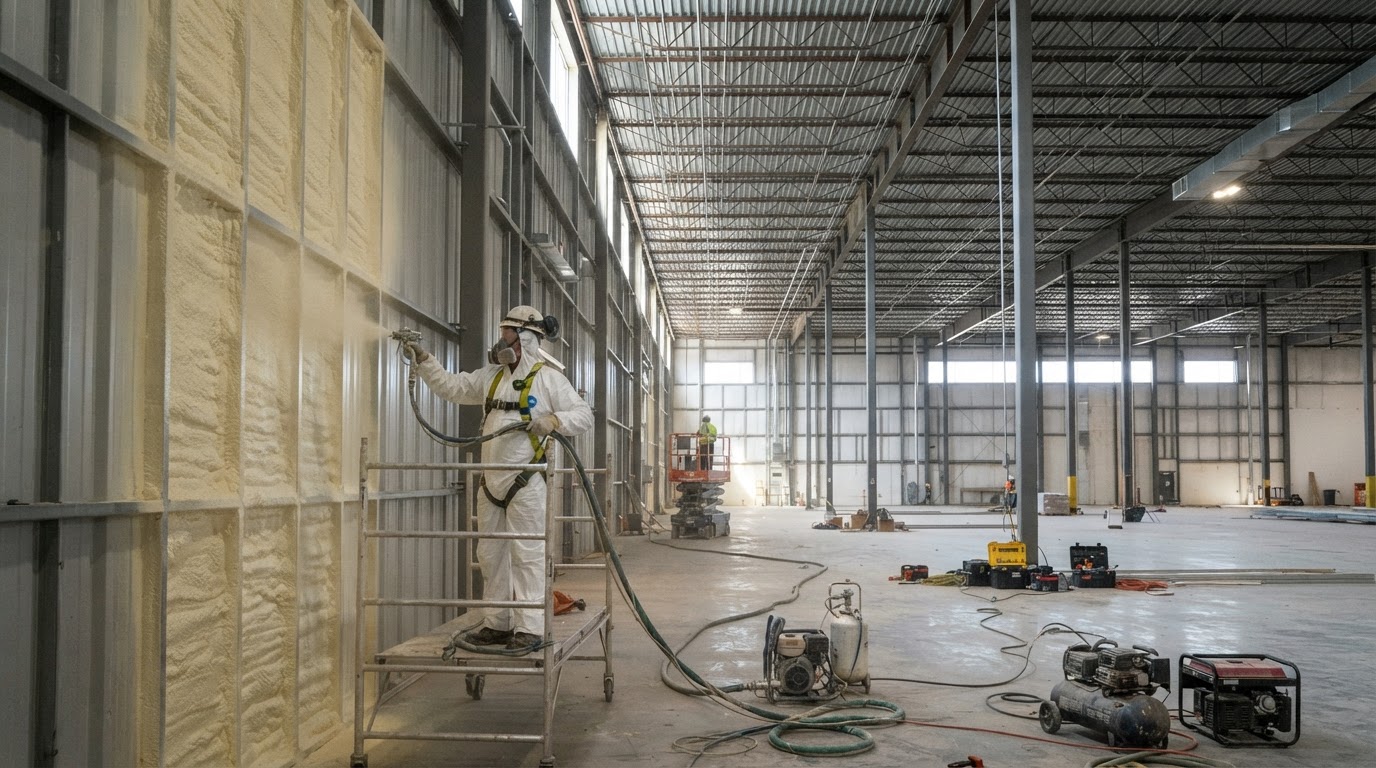
Commercial spray foam is for buildings with expansive roof and wall assemblies where air leakage and radiant heat transfer have a large surface area to act on. In a Huntsville warehouse or shop, an uninsulated or under-insulated metal roof can radiate intense heat into the space in summer and allow condensation in cool, humid conditions. Spray foam applied to those assemblies can help slow that heat transfer and reduce air infiltration in one application.
This service is for owners of warehouses, storage buildings, light manufacturing spaces, retail and service buildings, and new commercial construction. It also applies to retrofit situations where interior framing or paneling is exposed during a renovation, tenant build-out, or expansion. Not every commercial space can be retrofitted without exposing the substrate, and we will tell you honestly what access is required.
Because commercial buildings vary so much — from clear-span steel shells to framed retail interiors — the conversation starts with how the building is used, what conditions it needs to maintain, and what assemblies are accessible. A conditioned storage building has different requirements than a workshop with welding equipment, which is different again from a climate-controlled office space.
Why use spray foam in a commercial building?
Spray foam insulates and air seals large commercial roof and wall assemblies in one application, which can help stabilize interior conditions and reduce uncontrolled air movement. In Huntsville's hot, humid climate that can matter for buildings with expansive metal envelopes and high heat and humidity exposure.
Benefits and Application Considerations for Commercial Buildings
Commercial envelopes behave differently from residential ones because of scale and materials. These considerations guide how we plan a commercial spray foam project in North Alabama.
Large-envelope air sealing
Spray foam can provide a continuous air barrier across expansive roof and wall assemblies, which can help reduce uncontrolled air movement that drives HVAC load in large buildings.
Metal building compatibility
Closed-cell foam bonds to steel panels and purlins, which is why it is common in commercial metal buildings. See our metal building spray foam insulation page for condensation detail.
Retrofit and new construction
Spray foam works in new commercial construction before interior finishes and in retrofits where the substrate is exposed during renovation or build-out, with access assessed case by case.
Use-driven specification
A conditioned warehouse, a workshop, and a retail space have different needs; we tailor thickness and product to how the building is actually used rather than a default.
Product and Application Guidance for Larger Building Assemblies
On a large commercial envelope, the product choice is tied closely to the substrate and the condensation strategy. Here is how the options are typically weighed.
Closed-cell spray foam is frequently specified for commercial metal buildings because it bonds directly to steel, delivers a high approximate R-value per inch, and has lower vapor permeance at sufficient thickness — useful where condensation control is a concern. For buildings with framed interior walls and conditioned office space, open-cell foam may be considered for those cavities where vapor permeability is acceptable.
Thickness and application strategy depend on the assembly, the interior use, and the building's mechanical setup. We do not assume a single thickness across every building; the goal is to match the foam to the structure and the conditions it has to perform under.
Steel roof and wall panels
Closed-cell foam is typically applied directly to corrugated steel and purlins where condensation control and high R-value per inch are priorities.
Framed interior assemblies
Open-cell foam may be used in framed interior partitions or office build-outs where vapor permeability suits the assembly and cavity depth allows.
The Commercial Spray Foam Project Process
Commercial projects move differently than residential ones because of scale, occupancy, and coordination with other trades. Here is how we approach a commercial build.
Review building use and goals
We discuss how the building is used, what interior conditions it needs, and whether it is new construction, a retrofit, or a tenant build-out.
Assess the envelope and access
We inspect the roof and wall assemblies, substrate condition, and what access is available — clear-span steel shells and framed interiors have very different requirements.
Specify product and thickness
We recommend open-cell or closed-cell foam and a target thickness based on the assembly, condensation strategy, and the building's mechanical setup.
Coordinate and install
We schedule around occupancy and other trades, prepare the space, apply the foam with calibrated equipment, and leave the site ready for interior finishes.
Related Spray Foam Services
Huntsville's commercial landscape includes warehouses, storage buildings, and light-industrial structures, so we plan around business operations and coordinate timing to minimize disruption where possible.
Commercial Spray Foam FAQs for Huntsville Property Owners
Questions from business owners, builders, and facility managers evaluating commercial spray foam in Huntsville and the Tennessee Valley.
Can spray foam be used in commercial buildings?
Is closed-cell foam used in metal commercial buildings?
Can existing commercial spaces be retrofitted?
How is commercial spray foam cost determined?
Does installation interrupt business operations?
What should a commercial property owner consider before installation?
Discuss Your Commercial Spray Foam Project in Huntsville
For warehouses, shops, storage buildings, and new commercial construction in Huntsville and the Tennessee Valley, Huntsville Spray Foam Installation can evaluate your envelope and recommend an appropriate approach. Call (256) 361-1406 or request an estimate to discuss your building.