Attic Spray Foam Insulation in Huntsville, AL
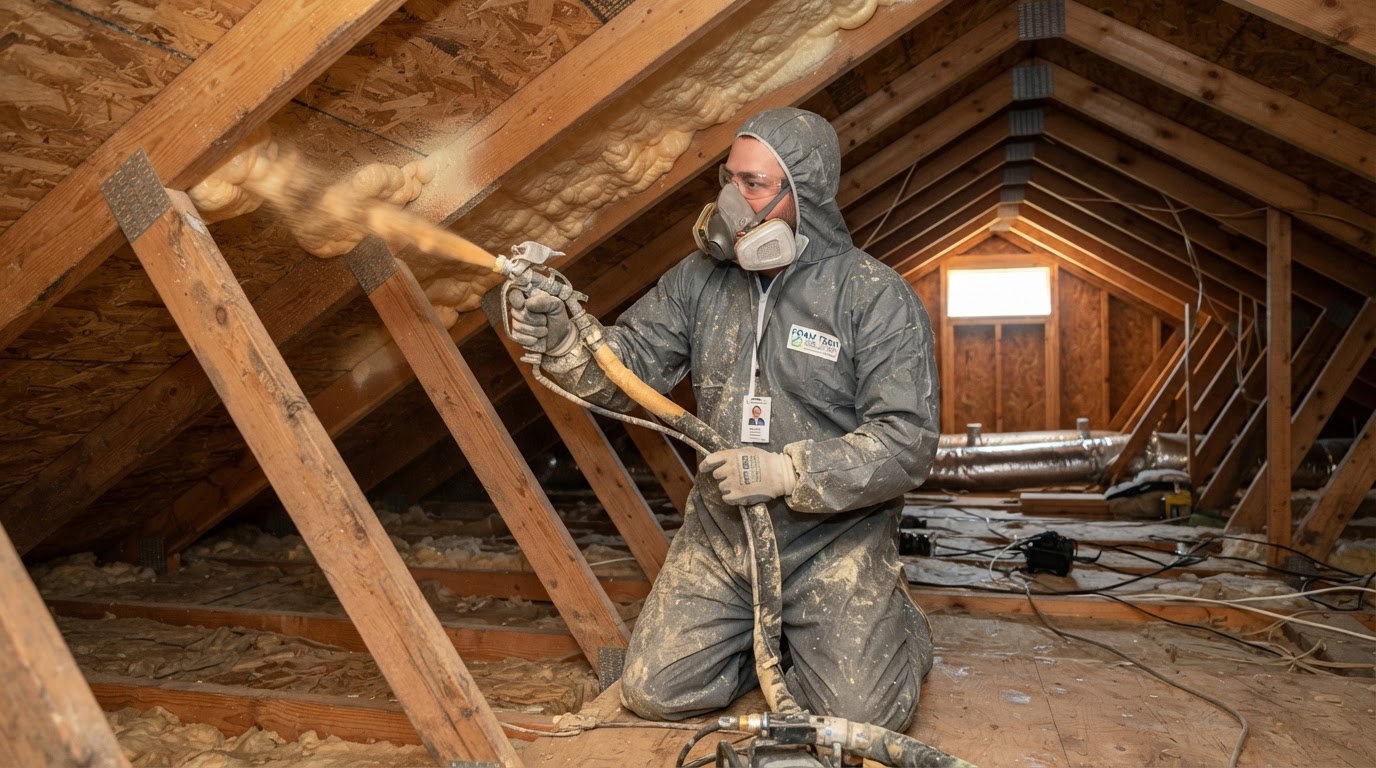
Attic spray foam insulation applies spray polyurethane foam to the underside of the roof deck and rafters to move the thermal and air barrier to the roofline, creating a conditioned or semi-conditioned attic. For homeowners in Huntsville, Alabama, this can help keep attic ductwork in a tempered space and reduce extreme attic heat transfer when the assembly is appropriate and existing insulation and ventilation are evaluated first.
Huntsville Spray Foam Installation helps homeowners across Huntsville and the Tennessee Valley evaluate whether attic spray foam is right for their roofline. A vented attic with insulation on the floor and a conditioned attic with foam on the roof deck are different building-science strategies, and the right choice depends on where your ductwork sits, the roof assembly, existing insulation, and your goals. We do not assume every attic should be foamed at the roofline.
Request an Insulation Estimate
Tell us about your attic spray foam insulation project.
How Attic Spray Foam Differs from Conventional Attic-Floor Insulation
Conventional attic insulation sits flat on the drywall ceiling, leaving the attic above unconditioned and exposed to outdoor temperatures. In a Huntsville summer, that unconditioned attic can reach extreme temperatures, and any ductwork or air handler located there sits in hostile air. Attic-floor insulation slows heat moving through the ceiling but does nothing to protect the ductwork or address the heat radiating down from a hot roof deck.
Attic spray foam moves the thermal boundary to the underside of the roof deck, bringing the attic inside the conditioned envelope. When the roofline is sealed, ductwork and equipment in the attic sit in a much milder space, which can help reduce the cooling strain caused by hot attic air. That is the core difference: attic-floor insulation protects the rooms below, while roofline foam protects the attic itself and everything in it.
This is not automatically the right move for every home. The decision depends on whether ductwork is in the attic, the roof assembly, access, and whether existing insulation should be evaluated or removed. We assess these before recommending a roofline approach.
How does attic spray foam differ from conventional attic-floor insulation?
Conventional insulation sits on the attic floor and leaves the attic unconditioned, while roofline spray foam moves the thermal and air barrier to the underside of the roof deck, bringing the attic into the conditioned envelope. That can help protect attic ductwork from extreme heat, but it is not right for every roof assembly.
Attic Air Leakage, Roof Decks, and Building-Envelope Considerations
Attic performance in North Alabama is driven by heat, air leakage, and where your ductwork sits. These are the considerations behind an attic spray foam project.
Ductwork in the attic
When HVAC equipment and flex ducts sit in a vented attic, roofline foam can bring them into conditioned space, which may help reduce the cooling strain caused by extreme attic temperatures.
Air leakage at the ceiling
Recessed lights, attic hatches, and plumbing chases allow conditioned air to escape and hot, humid air to enter. Roofline foam addresses the air barrier at the roof plane rather than the ceiling.
Existing insulation
Existing loose-fill or batt insulation should be evaluated, and in some roofline designs removed, before spraying the deck. The right approach depends on the assembly and goals.
Ventilation and building science
Converting a vented attic to an unvented conditioned assembly is a building-science decision that depends on the roof design — we do not assume vents should always be sealed for every home.
Roof Deck & Attic Spray Foam Considerations: Open vs. Closed Cell
Both open-cell and closed-cell foam are used on rooflines, and the choice depends on the roof assembly, climate, and the building-science approach taken.
Open-cell foam is commonly used on attic rooflines in our region because it expands to fill rafter bays and is vapor permeable, which lets the roof assembly dry in designs where that is intended. Closed-cell foam is sometimes selected where higher R-value per inch or a vapor retarder is desired, and where cavity depth is limited.
The decision is not about which product is universally better; it is about matching the foam to the roof assembly and the building-science strategy, including how the roof is designed to manage moisture. We do not imply that one approach works on every roof deck.
| Roofline consideration | Open-Cell on the Roofline | Closed-Cell on the Roofline |
|---|---|---|
| Expansion | Expands to fill deep rafter bays | Less expansion, higher density |
| Vapor behavior | Vapor permeable; assembly dries | Lower permeance at thickness |
| Typical use | Deep rafter rooflines | Shallow cavities, vapor-retarder designs |
Planning an Attic Spray Foam Project in Huntsville
An attic project starts with understanding what is up there now and what you want to improve. Here is how we approach it.
Assess access and existing insulation
We look at attic access, the current insulation, where ductwork and equipment sit, and the condition of the roof deck and framing.
Evaluate the roofline approach
We determine whether a roofline (conditioned attic) approach suits your roof assembly and goals, or whether attic-floor insulation is the better strategy.
Address existing insulation if needed
Where a roofline design calls for it, we discuss evaluating or removing existing loose-fill or batt insulation before spraying the deck.
Prepare, apply, and verify
We mask the area, confirm the substrate is dry, apply foam to the roof deck and gable walls as planned, and verify coverage before cleanup.
Related Spray Foam Services
Huntsville attics see extreme summer heat, so ductwork location and roof assembly matter a great deal. A home with a finished bonus room over a vented attic has different considerations than a simple storage attic.
Attic Spray Foam FAQs for Huntsville Homeowners
Frequent questions about insulating an attic roofline in Huntsville and the Tennessee Valley.
Can spray foam be applied to the underside of a roof deck?
Should old insulation be removed first?
Open-cell or closed-cell for an attic?
Does an attic need to be vented after spray foam?
Can spray foam help with attic air leakage?
How much does attic spray foam cost in Huntsville?
Talk With a Huntsville Attic Spray Foam Contractor
If your attic is brutally hot, your ductwork is up there, or you are planning a conditioned attic, Huntsville Spray Foam Installation can evaluate your roofline and recommend an appropriate approach. Call (256) 361-1406 or request an estimate.