Closed Cell Spray Foam Insulation in Huntsville, AL
Closed-cell spray foam is a high-density (approximately 2.0 lb/cu ft) spray polyurethane foam whose cells remain sealed, making it rigid and giving it a higher R-value per inch and lower vapor permeance at sufficient product-specific thicknesses than typical open-cell products. For metal buildings, crawl spaces, and specialty assemblies in Huntsville, Alabama, it is commonly selected where moisture exposure, condensation control, or limited cavity depth are concerns.
Huntsville Spray Foam Installation installs closed-cell spray foam across Huntsville and the Tennessee Valley. Closed-cell is the second of the two main spray foam families, and it has a distinct set of properties that make it the right choice for certain assemblies — particularly metal buildings, crawl spaces, and moisture-prone or space-constrained areas. Two important honesty points: closed-cell is not universally waterproof, and we do not promise structural reinforcement. It is a high-density, low-permeance foam whose value is matched to specific assemblies.
Request an Insulation Estimate
Tell us about your closed cell spray foam insulation project.
What Closed Cell Spray Foam Is and Where It Is Used
Closed-cell foam gets its name from its cellular structure: the cells remain sealed during curing, which makes the foam rigid and dense. That sealed structure is what gives closed-cell its higher R-value per inch and its lower vapor permeance at sufficient product-specific thicknesses, compared with typical open-cell products. It is the foam most often selected where moisture exposure, condensation control, or limited cavity depth are concerns.
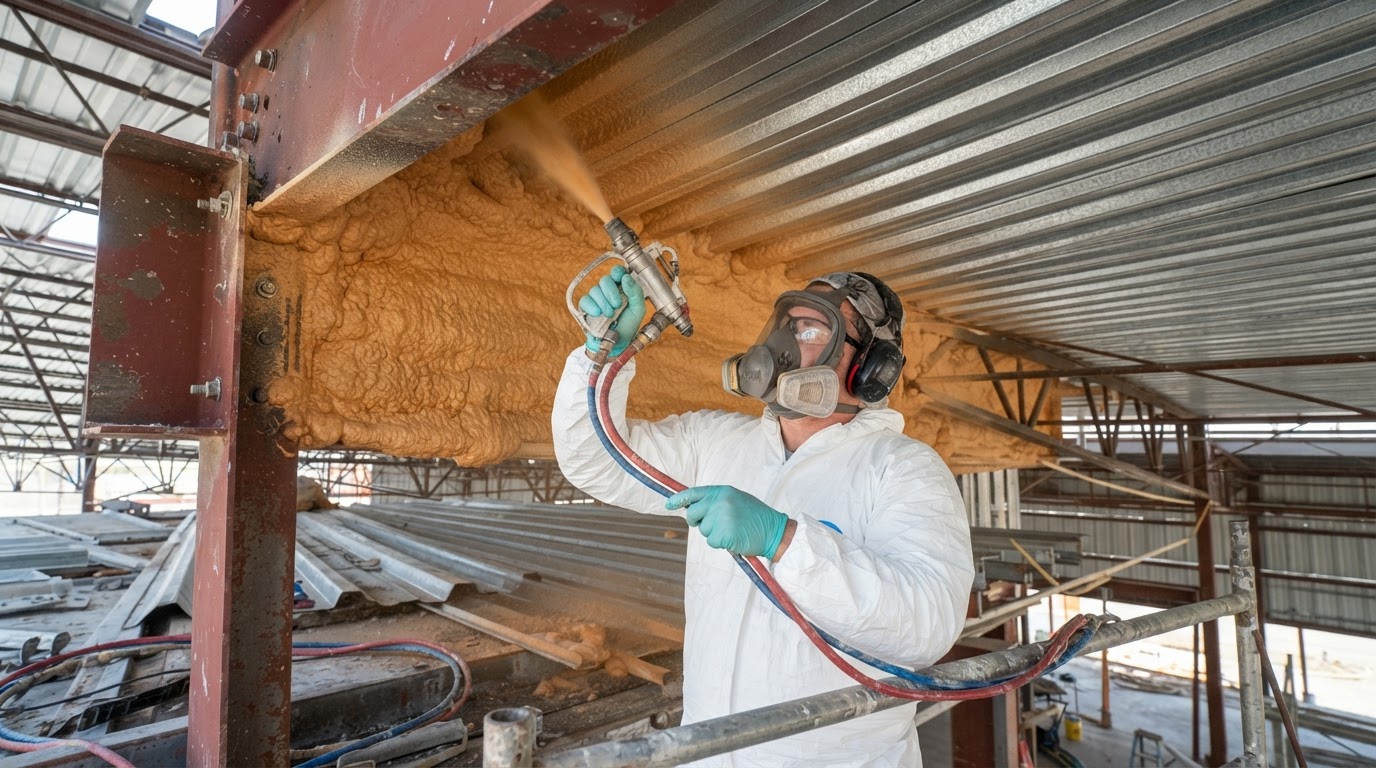
Closed-cell is commonly used on metal building walls and roofs, crawl space foundation walls and rim joists, and specialty assemblies where its properties are an advantage. Because it bonds directly to substrates and delivers high R-value per inch, it is well suited to metal skins and to shallow cavities where open-cell's expansion is not needed and where its permeability would be a drawback.
Two important clarifications: closed-cell is not universally waterproof — it resists moisture transmission at thickness but is not a waterproofing product — and we do not promise structural reinforcement. Its value is insulation, air sealing, and moisture-vapor management in suitable assemblies.
What is closed-cell spray foam?
Closed-cell spray foam is a high-density, approximately 2.0 lb/cu ft spray polyurethane foam with sealed cells that make it rigid, with a higher R-value per inch and lower vapor permeance at sufficient product-specific thicknesses than typical open-cell products. It is commonly selected for metal buildings, crawl spaces, and moisture-prone or space-constrained assemblies.
Benefits and Application Considerations for Closed-Cell Foam
Closed-cell foam has a distinct set of strengths tied to its sealed structure. These are the considerations behind a closed-cell project in North Alabama.
High R-value per inch
Closed-cell delivers a higher approximate R-value per inch than typical open-cell, which matters where cavity depth is limited.
Lower vapor permeance
At sufficient product-specific thickness, closed-cell acts as a vapor retarder, which is why it is selected for crawl spaces and metal buildings.
Direct-to-substrate bonding
Closed-cell bonds directly to steel panels, wood framing, and masonry, creating a continuous layer without air gaps behind it.
Moisture exposure, not waterproofing
Closed-cell resists moisture transmission at thickness but is not universally waterproof; it is selected for moisture-prone assemblies, not as a waterproofing product.
Closed Cell vs. Open Cell: A Neutral Comparison
Closed-cell and open-cell are complementary products. This is a neutral comparison for Huntsville property owners.
Closed-cell is higher density, expands less, and has lower vapor permeance at sufficient thickness; open-cell is lower density, expands more, and is vapor permeable. Closed-cell is often selected for metal buildings, crawl spaces, and moisture-prone or space-constrained areas; open-cell is commonly used in interior framed cavities and rooflines where expansion and permeability are advantages.
Neither product is universally better. The right choice depends on the assembly, moisture exposure, cavity depth, and project goals. We do not call closed-cell universally waterproof or promise structural reinforcement; we match it to assemblies where its properties are an advantage.
| Property | Closed-Cell (2.0 lb) | Open-Cell (0.5 lb) |
|---|---|---|
| Density | High density, rigid | Low density, soft |
| Expansion | Less expansion, dense | High expansion fills deep cavities |
| Vapor behavior | Lower permeance at thickness | Vapor permeable |
| Typical use | Metal, crawl spaces, moisture-prone areas | Interior walls, rooflines |
Planning a Closed-Cell Spray Foam Project
Closed-cell projects center on moisture-prone or space-constrained assemblies. Here is how we approach one.
Confirm the assembly suits closed-cell
We confirm the target is a metal skin, crawl space, rim joist, or space-constrained area where closed-cell's properties are an advantage.
Check moisture conditions
We ensure substrates are dry and that any active water intrusion or drainage issues are corrected first — closed-cell is not a waterproofing product.
Prepare the substrate
We mask contents and equipment, and confirm the substrate — steel, wood, or masonry — is clean and dry for bonding.
Apply, verify, and clean up
We apply closed-cell foam to the target thickness, verify coverage, and clean up while keeping the space serviceable.
Related Spray Foam Services
Closed-cell is the workhorse foam for Huntsville metal buildings, crawl spaces, and pole barns because of its lower permeance and high R-value per inch.
Closed Cell Spray Foam FAQs for Huntsville Property Owners
Frequent questions about closed-cell spray foam in Huntsville and the Tennessee Valley.
What is closed-cell spray foam?
Where is closed-cell foam commonly used?
Is closed-cell spray foam good for metal buildings?
Is closed-cell spray foam waterproof?
What is the approximate R-value of closed-cell spray foam?
How is closed-cell different from open-cell foam?
How much does closed-cell spray foam cost in Huntsville?
Talk With a Huntsville Closed Cell Spray Foam Contractor
For metal buildings, crawl spaces, pole barns, and moisture-prone assemblies in Huntsville and North Alabama, Huntsville Spray Foam Installation can evaluate the assembly and recommend an appropriate closed-cell approach. Call (256) 361-1406 or request an estimate.