Open Cell Spray Foam Insulation in Huntsville, AL
Open-cell spray foam is a low-density (approximately 0.5 lb/cu ft) spray polyurethane foam whose cells are intentionally broken open, making it soft, highly expanding, and vapor permeable. For homes and buildings in Huntsville, Alabama, it is commonly used in interior framed cavities, attics, and rooflines where high expansion, air sealing, and sound dampening are desired.
Huntsville Spray Foam Installation installs open-cell spray foam across Huntsville and the Tennessee Valley. Open-cell is one of the two main spray foam families, and it has a specific set of characteristics that make it well suited to certain assemblies and not others. Understanding what open-cell is — and what it is not — is the point of this page. It is not waterproof, and it is not appropriate for direct exterior exposure; it is a cost-effective, high-expanding air barrier for interior framed assemblies.
Request an Insulation Estimate
Tell us about your open cell spray foam insulation project.
What Open Cell Spray Foam Is and Where It Is Used
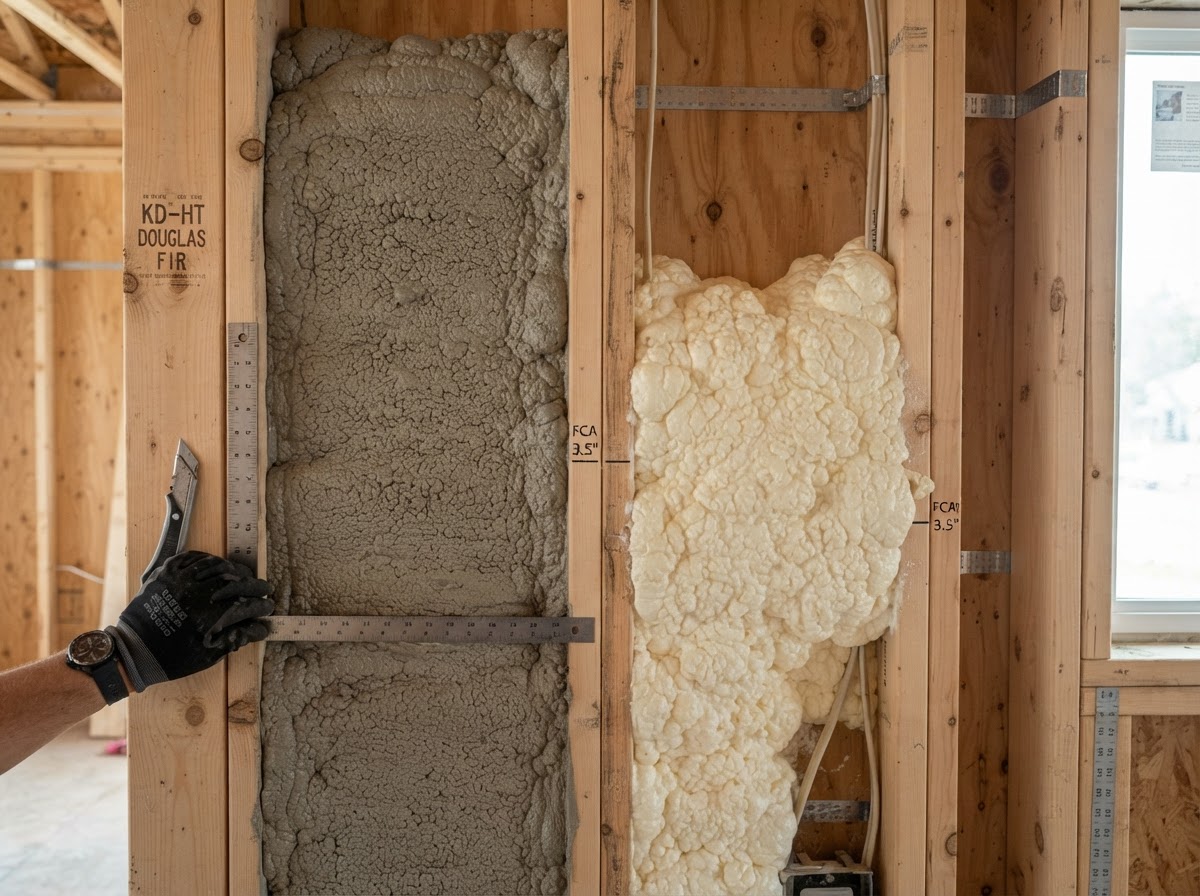
Open-cell foam gets its name from its cellular structure: the cells are broken open during curing, which makes the foam soft, light, and highly expanding. That structure is what gives open-cell its characteristics — it expands to fill deep framing cavities, it is vapor permeable so the assembly can dry, and it absorbs sound, which is why it is valued in interior walls and between rooms.
Open-cell is commonly used in interior residential wall cavities, attic rooflines with deep rafters, and framed assemblies where its expansion fills gaps and its permeability lets the assembly dry. It is not the right choice where moisture exposure, condensation control, or a vapor retarder are the priority — those are the domain of closed-cell foam.
An important distinction: open-cell is an air barrier at standard thickness, but it is not waterproof and is not appropriate for direct exterior exposure or for assemblies that will be wet. We match it to interior framed assemblies where its properties are an advantage.
What is open-cell spray foam?
Open-cell spray foam is a low-density, approximately 0.5 lb/cu ft spray polyurethane foam with broken-open cells that make it soft, highly expanding, and vapor permeable. It is commonly used in interior framed cavities, attics, and rooflines where high expansion, air sealing, and sound dampening are desired.
Benefits and Application Considerations for Open-Cell Foam
Open-cell foam has a clear set of strengths. These are the considerations behind an open-cell project in North Alabama.
High expansion
Open-cell expands to fill deep framing cavities, making it well suited to 2x6 and 2x8 walls and deep rafter bays.
Air sealing
At standard thickness, open-cell forms a continuous air barrier that helps reduce air leakage through framing gaps.
Sound dampening
Its open cellular structure absorbs airborne sound, which is a secondary benefit in interior walls and between rooms — not complete soundproofing.
Vapor permeability
Open-cell is vapor permeable, letting the assembly dry in designs where that is intended — and it is not appropriate where a vapor retarder is needed.
Open Cell vs. Closed Cell: A Neutral Comparison
Open-cell and closed-cell are complementary products with different properties. This is a neutral comparison for Huntsville property owners.
Open-cell is lower density, expands more, and is vapor permeable; closed-cell is higher density, expands less, and has lower vapor permeance at sufficient thickness. Open-cell is commonly used in interior framed cavities and rooflines; closed-cell is often selected for metal buildings, crawl spaces, and where a vapor retarder or higher R-value per inch is desired.
Neither product is universally better. The right choice depends on the assembly, moisture exposure, framing depth, and project goals. Open-cell's R-value is approximate and product-dependent, and closed-cell offers a higher R-value per inch, which matters where cavity depth is limited.
| Property | Open-Cell (0.5 lb) | Closed-Cell (2.0 lb) |
|---|---|---|
| Density | Low density, soft | High density, rigid |
| Expansion | High expansion fills deep cavities | Less expansion, dense |
| Vapor behavior | Vapor permeable | Lower permeance at thickness |
| Typical use | Interior walls, rooflines | Metal, crawl spaces, moisture-prone areas |
Planning an Open-Cell Spray Foam Project
Open-cell projects are about matching the foam to interior framed assemblies. Here is how we approach one.
Confirm the assembly is interior framed
We confirm the target is an interior framed wall, roofline, or cavity where open-cell's expansion and permeability are an advantage.
Check cavity depth
We verify framing depth is sufficient for open-cell expansion and the desired total R-value, since open-cell's per-inch R-value is approximate and product-dependent.
Prepare the framing
We mask windows, doors, and mechanical equipment and confirm substrates are dry and clean for adhesion.
Apply, verify, and clean up
We apply open-cell foam to the framing, verify coverage, trim excess where flush studs are needed, and clean up.
Related Spray Foam Services
Open-cell is a common choice for Huntsville residential rooflines and interior walls because of its expansion and permeability in our climate.
Open Cell Spray Foam FAQs for Huntsville Property Owners
Frequent questions about open-cell spray foam in Huntsville and the Tennessee Valley.
What is open-cell spray foam?
Where is open-cell foam commonly used?
Is open-cell spray foam an air barrier?
Is open-cell spray foam waterproof?
What is the R-value of open-cell spray foam?
Open-cell or closed-cell for a Huntsville attic?
How is open-cell spray foam priced?
Talk With a Huntsville Open Cell Spray Foam Contractor
If you are considering open-cell spray foam for an attic, interior walls, or framed assembly in Huntsville or North Alabama, Huntsville Spray Foam Installation can evaluate the assembly and confirm whether open-cell is the right fit. Call (256) 361-1406 or request an estimate.