Spray Foam Insulation in Huntsville, AL
Spray foam insulation is a two-component polyurethane product sprayed onto building cavities, roof decks, and steel framing where it expands and cures into a continuous layer that provides both thermal resistance and air sealing. In Huntsville, Alabama, it is used on homes, attics, crawl spaces, metal buildings, pole barns, workshops, barndominiums, and new construction to help control air leakage and heat transfer across the building envelope.
Huntsville Spray Foam Installation provides spray polyurethane foam (SPF) insulation for residential and commercial properties throughout Huntsville, Alabama and the surrounding Tennessee Valley. Whether your priority is a cooler attic, a drier crawl space, a more usable workshop, or a tighter new-construction envelope, spray foam is evaluated against the specific assembly, climate exposure, and performance goals of your project rather than applied as a one-size-fits-all product. This page is the central hub for our spray foam services in Huntsville and links to each specialized application below.
Request an Insulation Estimate
Tell us about your spray foam insulation project.
How Spray Polyurethane Foam Works as Insulation and Air Sealing
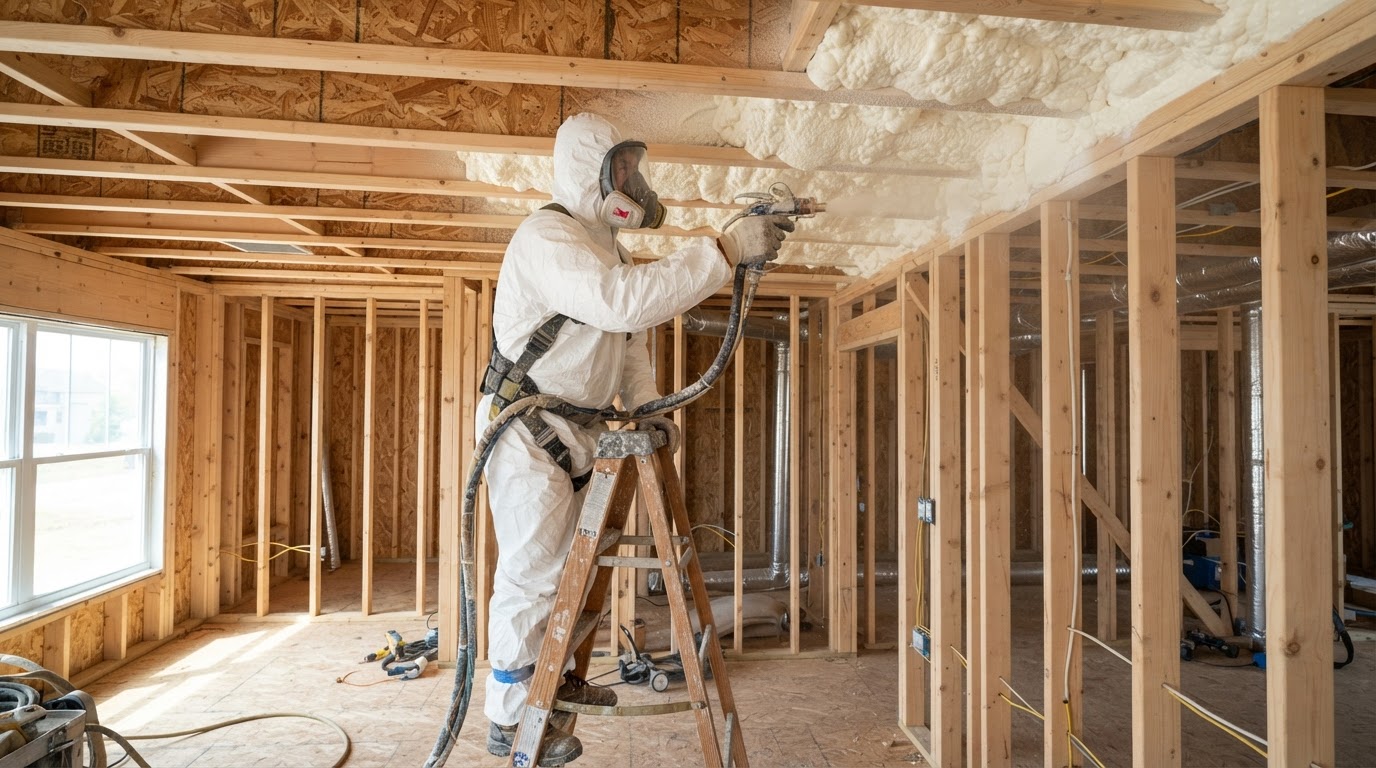
Spray polyurethane foam is produced on site by combining a resin blend with an isocyanate component under heat and pressure. As the mixed material leaves the spray gun it expands within seconds, filling gaps, voids, and irregular framing joints before curing into a semi-rigid or rigid cellular plastic. That cured foam both resists conductive heat flow and forms a physical air barrier, which is what separates SPF from fiber insulations that slow heat transfer but still allow air to move through gaps around them.
For property owners in Huntsville and across North Alabama, that combined insulation-and-air-sealing behavior matters because the climate drives two problems at once: intense summer heat through rooflines and metal panels, and humid air moving through unsealed penetrations year-round. Air leakage through recessed lights, plumbing chases, rim joists, and soffit gaps can carry moisture and heat into conditioned space. When properly specified and installed, spray foam addresses the thermal and the air-leakage side of that equation in a single application.
Product selection still depends on the assembly. Open-cell foam and closed-cell foam behave differently, and neither is correct for every surface. The right approach depends on framing depth, moisture exposure, substrate material, available cavity depth, and the desired performance of the finished assembly, which is why we evaluate each project individually.
What is spray foam insulation?
Spray foam insulation is spray polyurethane foam (SPF), a two-component material sprayed onto building assemblies where it expands and cures into a continuous layer that insulates and air seals at the same time. It is used on attics, crawl spaces, walls, roof decks, and metal buildings to help reduce air leakage and heat transfer across the building envelope.
Spray Foam Applications We Handle Across Huntsville
Spray foam is versatile, but the way it is used changes with the structure. These are the primary applications we evaluate for property owners in Huntsville and surrounding North Alabama communities.
Residential homes
Whole-home envelopes for existing homes, renovations, and additions — including rooflines, wall cavities, and crawl spaces. See our residential spray foam insulation page for homeowner-focused guidance.
Commercial buildings
Larger commercial and light-industrial envelopes where air sealing expansive roof and wall assemblies supports stable interior conditions. Our commercial spray foam page covers facility considerations.
Attics and roof decks
Roofline applications that can move the thermal boundary to the underside of the roof deck. Our attic spray foam insulation page walks through vented vs unvented considerations.
Crawl spaces
Foundation wall and rim-joist air sealing for damp North Alabama crawl spaces. Our crawl space spray foam page addresses moisture sources and assembly options.
Metal buildings & pole barns
Direct-to-steel applications for shops, storage, and post-frame structures. Our metal building and pole barn spray foam pages cover condensation considerations.
Workshops & barndominiums
Detached shops and post-frame residences that need a tight envelope for efficient conditioning. Our workshop and barndominium spray foam pages address mixed-use buildings.
Open Cell vs. Closed Cell Spray Foam at a Glance
Most spray foam questions come down to choosing between open-cell and closed-cell products. Both insulate and air seal, but their density, vapor behavior, and best-fit assemblies differ.
Open-cell spray foam is a low-density, flexible material that expands substantially to fill deeper cavities. It is commonly used in interior residential framing and attic rooflines where cavity depth allows and where vapor permeability is acceptable for the assembly.
Closed-cell spray foam is a denser, rigid material that delivers a higher approximate R-value per inch and has lower vapor permeance at sufficient thickness. It is often selected for crawl spaces, metal buildings, and assemblies where space is limited or where a vapor retarder is desired.
| Consideration | Open-Cell Spray Foam | Closed-Cell Spray Foam |
|---|---|---|
| Density | ~0.5 lb/cu ft (product dependent) | ~2.0 lb/cu ft (product dependent) |
| Approx. R-value per inch | ~R-3.5 to R-3.8 (product dependent) | ~R-6.0 to R-7.0 (product dependent) |
| Vapor behavior | Vapor permeable; lets assemblies dry | Lower permeance at adequate thickness |
| Common Huntsville uses | Interior walls, attic rooflines | Crawl spaces, metal buildings, shops |
Our Spray Foam Installation Process in Huntsville
Each project follows a structured sequence, but the details adapt to the building type and assembly. Here is how a typical spray foam project moves from first call to finished installation.
Discuss the project
We review your building type, target assembly, comfort or performance goals, timeline, and occupancy so we understand what you are trying to achieve before recommending a product.
Evaluate the assembly
We look at framing depth, roofline configuration, substrate material, existing insulation, moisture conditions, and access to confirm suitability for spray foam.
Select the product and approach
We specify open-cell or closed-cell foam, target thickness, and the application strategy based on the assembly and project objectives rather than a default assumption.
Prepare and apply
We mask sensitive areas, confirm substrates are dry, apply the foam in measured passes with calibrated equipment, and allow proper cure before finishing.
Review and clean
We verify coverage, trim excess where finishes require flush surfaces, remove masking, and leave the work area clean and ready for the next trade.
Related Spray Foam Services
Preparation and installation requirements vary by property, project stage, and assembly. Huntsville-area homes, shops, and new-construction builds each have different access and sequencing considerations.
Spray Foam Insulation FAQs for Huntsville Property Owners
These are the most common questions we hear from homeowners, builders, and property owners evaluating spray foam in Huntsville and the surrounding Tennessee Valley.
What is spray foam insulation?
Is spray foam a good option in Huntsville, AL?
What is the difference between open-cell and closed-cell spray foam?
Where can spray foam be installed?
How long does spray foam installation take?
How much does spray foam cost in Huntsville?
How do I request a spray foam estimate near Huntsville?
Talk With a Huntsville Spray Foam Contractor About Your Project
From a residential attic conversion and crawl space air sealing to a metal building, pole barn, workshop, barndominium, or new-construction envelope, Huntsville Spray Foam Installation is ready to discuss your building-envelope goals and provide a detailed estimate for your property.