Spray Foam Insulation in Athens, AL
Huntsville Spray Foam Installation provides spray foam insulation for homes, attics, workshops, pole barns, and new construction in Athens, Alabama and the surrounding Limestone County area. Open-cell and closed-cell spray polyurethane foam can be evaluated for residential and post-frame building envelopes across the western Tennessee Valley.
Athens combines a historic residential core with growing new construction and a strong presence of detached shops, post-frame buildings, and rural outbuildings across Limestone County. That variety makes workshop, pole-barn, and new-home applications especially relevant here, alongside attic and crawl-space work for existing homes.
Request an Insulation Estimate
Tell us about your spray foam project in Athens.
Spray Foam for Homes and Workshops in Athens
Spray polyurethane foam expands on application to combine insulation with air sealing, adhering to framing, posts, and panels to fill the gaps and penetrations where air leakage occurs. For Athens properties, that dual function is useful across both tight residential envelopes and the larger, more irregular cavities found in post-frame buildings.
Limestone County's climate features long humid summers and noticeable winter temperature swings. In homes, that means hot attic air and humid crawl spaces drive comfort and cooling concerns. In workshops and pole barns, large rooflines and metal or wood skin can allow substantial heat gain in summer and cold-air movement in winter, making a continuous envelope harder to achieve with conventional insulation alone.
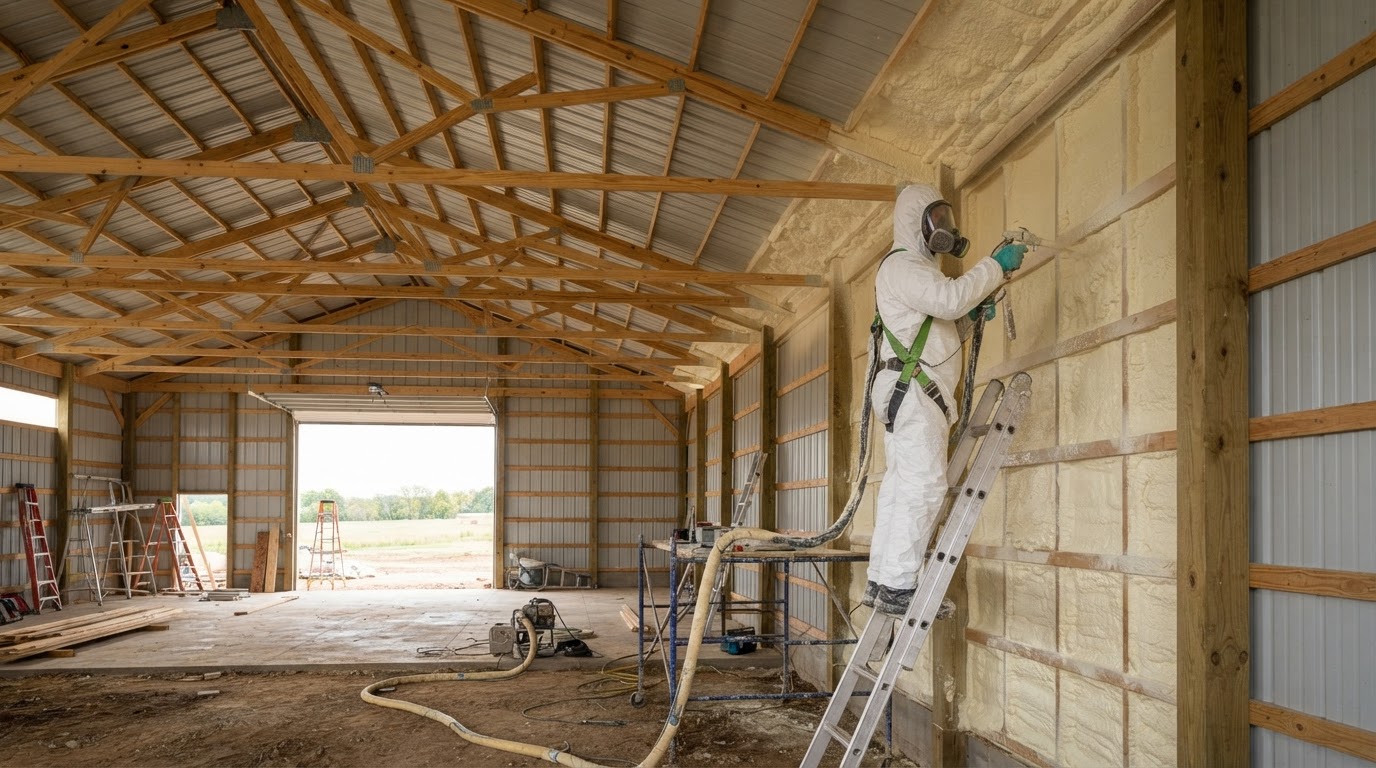
Post-frame and workshop buildings often have wide-spaced girts and big open roof cavities where batts and blankets sag, gap, or leave the framing exposed. Spray foam conforms to posts, purlins, and wall framing to help create a more continuous air and thermal layer when the building is intended to be conditioned.
Each Athens project is reviewed on its own conditions. Huntsville Spray Foam Installation does not assume that every outbuilding needs conditioning or that one foam type suits every assembly.
Because Athens sits at the western edge of the Huntsville metro and stretches into rural Limestone County, the building mix here runs from subdivision homes to larger acreage properties with detached shops and barns. A spray foam plan that makes sense for a subdivision attic can be quite different from one for a post-frame shop on acreage, so the evaluation accounts for building type, occupancy, and how each space is actually used.
Athens also sees its share of new residential construction. Where framing is still open, spray foam can be sequenced with the plumber, electrician, and HVAC contractor so the envelope is continuous before drywall closes in. That pre-drywall window is the most flexible point for a full-envelope application and is where the cleanest result is usually achievable.
Is spray foam a good fit for homes and workshops in Athens, AL?
Spray foam can be a strong fit for many Athens homes and workshops when the assembly and product are matched correctly. For homes it can help air-seal attics and crawl spaces; for workshops and pole barns it can conform to post-frame framing to create a more continuous envelope. Suitability depends on whether the building will be conditioned and on the specific assembly.
Residential Spray Foam in Athens, AL
Athens homes range from older established properties to active new construction, and residential spray foam is evaluated across attics, crawl spaces, and pre-drywall envelopes.
Existing Athens homes are commonly reviewed at the attic and crawl space. Attic spray foam at the roof deck can help address ceiling-plane air leakage and bring ductwork into a more tempered zone, while crawl space spray foam on perimeter walls and rim joists can help limit humid ground-air infiltration. Moisture and water sources are checked first, since foam does not correct active intrusion.
For new homes and additions, new construction spray foam planned before drywall lets the foam wrap framing and rim joists continuously. Older homes are evaluated where framing is accessible during renovation.
Whole-home guidance is covered on the residential spray foam insulation page.
A practical note for Athens homeowners: not every existing wall cavity can be spray foamed without access. Injected or cavity applications depend on whether the wall can be opened or whether a suitable access method exists. For most occupied older homes, the highest-value spray foam opportunities remain the attic roofline and the crawl space, where access is straightforward and the air-leakage payoff is typically greatest.
Attics & Rooflines
Roof-deck and rafter applications reviewed for air leakage, duct placement, and conditioned-attic strategy based on the existing assembly.
Crawl Spaces & Rim Joists
Perimeter and rim-joist sealing considered for humid ground-air control, with moisture sources identified before application.
New Construction
Pre-drywall envelope planning coordinated with framing and mechanical schedules for a continuous air and thermal barrier.
Remodels & Additions
Where framing is opened, spray foam can be evaluated for cavities that conventional insulation leaves drafty.
Pole Barn & Metal Building Spray Foam Near Athens
Athens and Limestone County include many detached shops, post-frame buildings, and metal structures where spray foam can be evaluated for conditioning and envelope continuity.
Detached workshops are a frequent Athens project. Workshop spray foam can help make a conditioned shop easier to heat and cool by air-sealing walls and rooflines. Shops used for welding, woodworking, or combustion equipment may have separate ventilation and safety needs that insulation does not address.
Post-frame buildings are common across the area, and pole barn spray foam can be evaluated for walls and roof assemblies when the building will be conditioned. Foam type and thickness depend on whether the structure will be climate-controlled and on the metal or wood skin present; not every agricultural building needs conditioning.
Metal structures can also be reviewed with metal building spray foam options, often leaning toward closed-cell spray foam for its density and lower vapor permeance at sufficient thickness, with condensation strategy considered.
One detail that comes up on Athens acreage properties is the sequencing of pole-barn and workshop insulation against interior finish plans. If the owner intends to frame out interior walls or install a ceiling later, that affects where the foam is applied and how thick. Spraying before interior framing lets the foam cover the full cavity and skin; spraying after can leave gaps. Reviewing the finished-use plan first avoids a costly rework later.
Detached Workshops
Wall and roofline air sealing for conditioned shops, with ventilation reviewed based on how the space is used.
Pole Barns & Post-Frame
Walls and roof assemblies evaluated for conditioning plans, with foam type matched to the skin and intended use.
Metal Buildings
Direct-to-panel spray foam considered for steel structures with condensation strategy reviewed alongside thickness.
New Construction
Pre-drywall planning for new homes and barndominiums that coordinates with framing and mechanical schedules.
Open Cell vs. Closed Cell Spray Foam in Athens
Athens projects span residential framing and post-frame buildings, so the open-cell versus closed-cell decision often varies even within a single property.
Open-cell foam is frequently considered for interior framed walls, attic rooflines, and sound-sensitive partitions where deep framing allows full fill. Closed-cell foam, with its higher approximate R-value per inch and lower vapor permeance at sufficient thickness, is often chosen for metal buildings, crawl spaces, and assemblies where condensation is a concern.
In post-frame buildings, the skin material and whether the space will be conditioned guide the choice. The comparison summarizes the main distinctions; actual performance depends on the specific product, thickness, and assembly.
| Property | Open-Cell Spray Foam | Closed-Cell Spray Foam |
|---|---|---|
| Density & structure | Lower-density, flexible open-cell matrix (~0.5 lb/cu ft) | Dense, rigid closed-cell matrix (~2.0 lb/cu ft) |
| Approx. R-value / inch | ~R-3.5–3.8 (product dependent) | ~R-6.0–7.0 (product dependent) |
| Air sealing | Forms an air barrier at typical thickness | Forms an air barrier at a thinner profile |
| Vapor permeance | Vapor permeable; allows assembly drying | Lower vapor permeance at sufficient thickness |
| Common Athens uses | Framed walls, attic rooflines, interior partitions | Metal buildings, crawl spaces, post-frame skins |
Spray Foam Installation Process for Athens Projects
Athens projects are reviewed in stages, with workshop and pole-barn work often requiring added attention to building use, ventilation, and whether the structure will be conditioned.
Discuss the Building & Use
We review the structure type, whether it will be conditioned, and how it is used, since these shape product selection for Athens homes, workshops, and pole barns.
Review Accessible Areas
We examine framing or post spacing, skin material, existing insulation, moisture conditions, and access to confirm the assembly is suitable for foam.
Determine the Product Approach
Open-cell or closed-cell and target thickness are selected based on the assembly, conditioning plans, and project objectives.
Prepare the Work Area
Contents and surfaces are protected, substrates are confirmed dry and clean, and ventilation is set up for the spraying operation.
Apply the Spray Foam
Technicians apply polyurethane foam in measured passes, allowing proper expansion and curing across walls and roof assemblies.
Review & Clean the Site
Coverage and depth are reviewed, excess foam is trimmed where finishes require it, and the work area is left clean.
Spray Foam Services for Athens Projects
For Athens workshops and pole barns, the key question is often whether the building will be conditioned. Answering that up front, along with how the space is used, helps match the foam type and avoid over- or under-specifying the envelope.
Spray Foam Service Areas Near Athens
Athens sits in Limestone County at the western edge of the company's service region, with nearby communities where similar residential, workshop, and post-frame projects come up.
Projects around Athens often overlap with neighboring Madison and Morgan county communities. The same evaluation process applies across the area, served from the Huntsville-area base, so properties just outside Athens are reviewed the same way as those within it.
Athens sits close enough to both Madison and Decatur that many property owners here compare quotes across the broader Huntsville metro. The spray foam evaluation itself—attic, crawl space, framing, moisture, and building-use review—does not change based on which neighboring community the property is nearest; the assembly and project goals drive the recommendation.
Spray Foam Insulation FAQs for Athens Property Owners
Questions from Athens homeowners, builders, and shop owners evaluating spray foam for homes, attics, workshops, and pole barns.
Can a pole barn near Athens be spray foamed?
Can spray foam be installed in a workshop?
Is open-cell foam suitable for attic applications?
What should be considered before spraying a metal building?
Can spray foam be planned during new construction?
How is an Athens spray foam estimate determined?
What should be considered before spraying a metal building near Athens?
Is open-cell foam suitable for attic applications in Athens homes?
Request a Spray Foam Estimate for Your Athens Project
Whether you are insulating a home attic, a detached workshop, or a post-frame building, Huntsville Spray Foam Installation can review your Athens property and recommend a suitable spray foam approach. Tell us about your project or call to discuss it directly.