Spray Foam Insulation in Decatur, AL
Huntsville Spray Foam Installation provides spray foam insulation for commercial buildings, metal structures, warehouses, workshops, and homes in Decatur, Alabama and the surrounding Morgan County area. Both open-cell and closed-cell spray polyurethane foam can be evaluated for larger building envelopes and residential assemblies across the Tennessee Valley.
Decatur's mix of industrial and commercial property, metal outbuildings, and established residential neighborhoods creates a broad set of insulation requirements. From commercial wall and roof assemblies to metal shops and existing-home attics, spray foam can be evaluated for many building types in the Decatur area, served from the company's Huntsville-area base.
Request an Insulation Estimate
Tell us about your spray foam project in Decatur.
Spray Foam Services Near Decatur, Alabama and the Building Envelope
Spray polyurethane foam expands on contact to deliver insulation and air sealing together. For Decatur's commercial and metal buildings, that matters because large steel envelopes lose heat through both conduction and uncontrolled air movement, and conventional blanket insulation often leaves gaps at purlins, fasteners, and penetrations where air and moisture move freely.
Decatur sits in the Tennessee Valley where summer heat and humidity are intense and winter cold snaps are common. In metal structures, warm interior air meeting cold steel panels can produce condensation drip, while in homes, hot attics and humid crawl spaces drive cooling loads and comfort complaints. Spray foam, when properly specified for the assembly, can help address both thermal transfer and air leakage.
Commercial and industrial envelopes often have different requirements than residential ones. Larger roof spans, metal substrates, occupancy type, and interior-use plans all influence whether open-cell or closed-cell is appropriate and how thick the application should be. The same holds for warehouses and storage-type structures, where condensation control and interior temperature stability may be priorities.
Decatur's position along the Tennessee River corridor means many commercial and metal structures here sit in humid, low-lying areas where condensation management is a real concern. Spray foam does not automatically eliminate all condensation—dewpoint, indoor humidity, and the assembly design all matter—but a direct-to-panel application can help separate warm interior air from cold steel and reduce the conditions that cause drip. The condensation strategy is reviewed alongside foam selection, not assumed.
Each Decatur building is reviewed on its own conditions. Huntsville Spray Foam Installation does not assume a single foam type suits every commercial or residential assembly in the area.
What types of buildings can be spray foamed near Decatur?
Spray foam can be evaluated for commercial buildings, metal structures, warehouses, workshops, pole barns, and homes near Decatur. Suitability depends on the substrate, assembly, occupancy, moisture strategy, and project goals. Closed-cell is often considered for metal and crawl-space applications, while open-cell is common in framed interior assemblies, with selection made per building.
Residential Spray Foam in Decatur and Morgan County
While Decatur's commercial presence is significant, many residential projects are also evaluated here, from older homes with hot attics to new construction and additions.
Existing Decatur homes are frequently reviewed at the attic and crawl space. Attic spray foam applied to the roof deck can help bring ductwork into a more tempered zone and reduce ceiling-plane air leakage, while crawl space spray foam on perimeter walls and rim joists can help limit humid ground-air infiltration. Active moisture or water issues are reviewed separately, since foam alone does not correct them.
For new homes and additions, planning new construction spray foam before drywall allows the envelope to be wrapped continuously. Older homes are evaluated where framing is accessible during renovation, and not every existing wall cavity is a candidate without access and preparation considerations.
Decatur's older housing stock often carries legacy fiberglass or cellulose that has settled, shifted, or been disturbed by wiring and duct changes over the years. Where that existing insulation is degraded or contaminated, removal and surface preparation are discussed before spray foam is applied. The goal is a clean, dry substrate so the new foam bonds properly and performs as intended rather than trapping moisture against an old layer.
Whole-home planning details are covered on the residential spray foam insulation page.
Existing-Home Attics
Roof-deck and ceiling-plane applications reviewed for air leakage, duct placement, and conditioned-attic strategy based on existing insulation and access.
Crawl Spaces & Rim Joists
Perimeter sealing considered for humid ground-air control; moisture sources are identified before foam is applied.
New Homes & Additions
Pre-drywall envelope planning coordinated with framing and mechanical schedules for a continuous air and thermal barrier.
Renovation Retrofits
Where framing is opened during remodels, spray foam can be evaluated for cavities that conventional insulation leaves drafty.
Metal Building Spray Foam Options for Decatur Projects
Decatur's commercial and industrial character makes metal-building and warehouse insulation a central topic for many projects evaluated here.
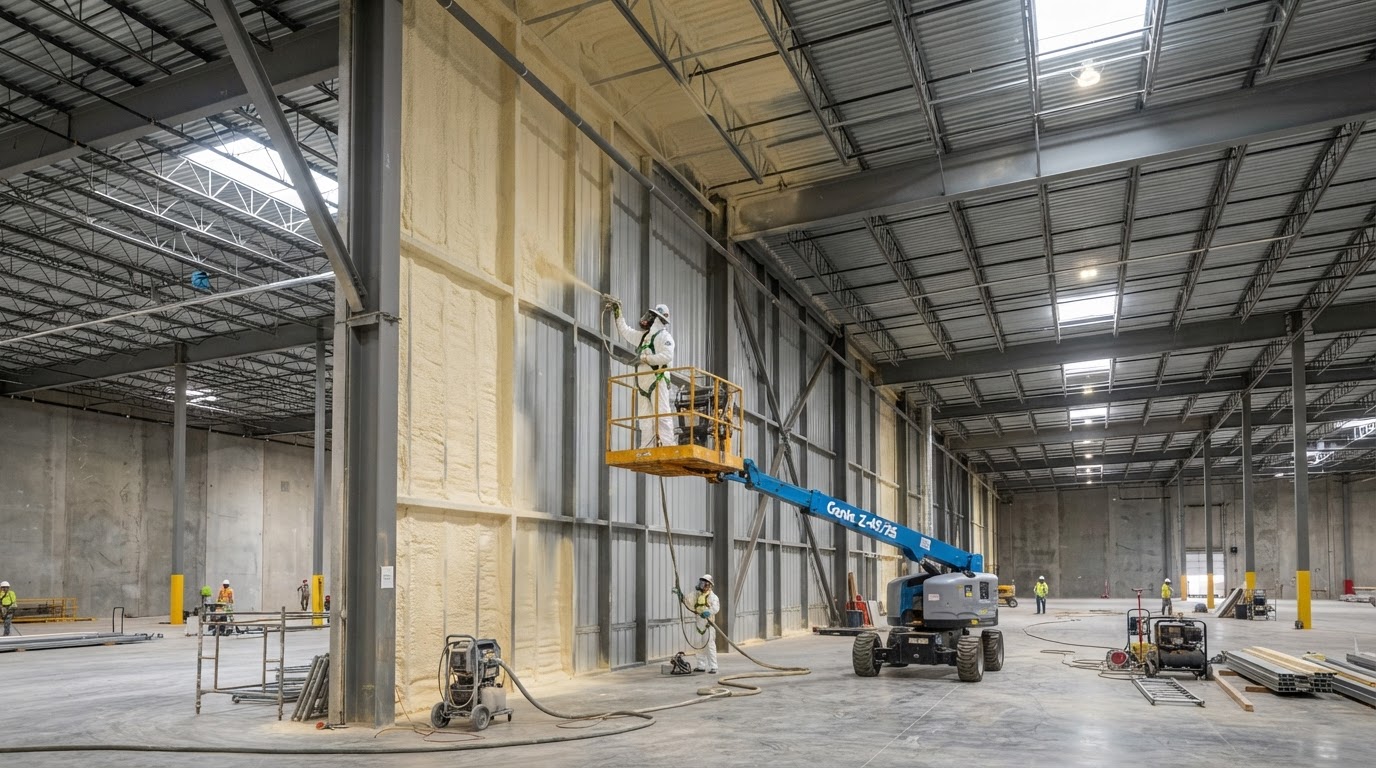
For steel and metal structures, metal building spray foam applied directly to wall panels and roof assemblies can help address radiant heat and air leakage. Condensation control depends on assembly design, indoor and outdoor conditions, foam selection, thickness, and moisture sources, so spray foam should not be described as automatically eliminating all condensation.
Larger commercial envelopes are reviewed with commercial spray foam options, where product and application are matched to building use, occupancy, and interior-finish plans. Closed-cell spray foam is frequently considered for metal walls and roofs because of its density and lower vapor permeance at sufficient thickness.
Decatur workshops, storage structures, and pole barns can also be evaluated. Workshop spray foam can help make a conditioned shop easier to manage, and pole barn spray foam applies to post-frame walls and roofs when conditioning is planned.
A common Decatur scenario is an existing metal shop or storage building that was built uninsulated and is now being brought into conditioned use. In that retrofit, panel condition, existing condensation staining, and any interior finish plans are reviewed first. Spray foam can then be applied directly to the steel, but the assembly must be suitable—rusted or oil-contaminated surfaces may need preparation before any foam will adhere properly.
Commercial Envelopes
Wall and roof assemblies reviewed for building use, occupancy, and interior-finish plans with product matched to the assembly.
Metal Buildings
Direct-to-panel spray foam evaluated for steel structures with condensation strategy considered alongside foam type and thickness.
Warehouses & Storage
Larger envelope applications where interior temperature stability and condensation control may be priorities.
Shops & Pole Barns
Workshop and post-frame structures evaluated for conditioning plans, with ventilation reviewed for how the space is used.
Open Cell vs. Closed Cell Spray Foam for Decatur Buildings
The open-cell versus closed-cell decision is especially relevant in Decatur's mix of metal and residential structures. The right choice depends on substrate, moisture strategy, framing depth, and project goals.
Closed-cell foam's density and lower vapor permeance at sufficient thickness make it a common consideration for metal buildings, crawl spaces, and assemblies where condensation is a concern. Open-cell foam's high expansion and flexibility suit deep framed cavities and interior sound-sensitive partitions. Both air-seal at appropriate thicknesses, but moisture behavior and typical applications differ.
Because Decatur projects span commercial steel envelopes and residential framing, the same property can require different products in different areas. The comparison summarizes the main distinctions; actual selection is product- and assembly-specific.
| Property | Open-Cell Spray Foam | Closed-Cell Spray Foam |
|---|---|---|
| Density & structure | Lower-density, flexible open-cell matrix (~0.5 lb/cu ft) | Dense, rigid closed-cell matrix (~2.0 lb/cu ft) |
| Approx. R-value / inch | ~R-3.5–3.8 (product dependent) | ~R-6.0–7.0 (product dependent) |
| Air sealing | Forms an air barrier at typical thickness | Forms an air barrier at a thinner profile |
| Vapor permeance | Vapor permeable; allows assembly drying | Lower vapor permeance at sufficient thickness |
| Common Decatur uses | Framed walls, attic rooflines, interior partitions | Metal buildings, crawl spaces, commercial envelopes |
Spray Foam Installation Process for Decatur Projects
Decatur projects are reviewed in stages, with commercial and metal buildings often requiring added attention to substrate condition, interior contents, and condensation strategy before foam is applied.
Discuss the Building & Use
We review the structure type, occupancy, interior-use plans, and whether the space will be conditioned, since these shape product selection for Decatur metal and commercial buildings.
Review Panel & Assembly Condition
We examine substrate condition, framing or panel access, existing insulation, and moisture indicators to confirm suitability for the intended application.
Determine the Product Approach
Open-cell or closed-cell and target thickness are selected based on the assembly, condensation strategy, and project objectives, not a default assumption.
Prepare the Work Area
Contents, equipment, and surfaces are protected, substrates are confirmed dry and clean, and ventilation is arranged for the spraying operation.
Apply the Spray Foam
Technicians apply polyurethane foam in measured passes, allowing proper expansion and curing across walls and roof assemblies.
Review & Clean the Site
Coverage and depth are reviewed, excess foam is trimmed where finishes require it, and the work area is left clean for operations or occupancy.
Spray Foam Services for Decatur Projects
For Decatur metal and commercial buildings, condensation strategy and interior-use plans often drive the approach. Reviewing how the building will be used and conditioned before selecting a foam type helps avoid mismatched applications.
Spray Foam Service Areas Near Decatur
Decatur anchors the western side of the company's North Alabama service region, with nearby communities where similar commercial, metal-building, and residential projects come up.
Projects around Decatur frequently overlap with neighboring Morgan and Cullman county communities. The same evaluation process applies across the area, served from the Huntsville-area base, so a property just outside Decatur is reviewed the same way as one within it.
Because Decatur sits roughly equidistant between Huntsville and the Cullman area, commercial and metal-building projects here sometimes share conditions with structures in Hartselle and Cullman rather than the Madison County communities to the east. The spray foam evaluation still follows the same assembly-by-assembly logic regardless of which neighboring community a building sits closest to.
Spray Foam Insulation FAQs for Decatur Property Owners
Questions from Decatur business owners, commercial property managers, and homeowners evaluating spray foam for metal, commercial, and residential structures.
Can spray foam be used in a Decatur metal building?
Is spray foam suitable for commercial properties?
Can older Decatur homes be evaluated for spray foam insulation?
Which foam is commonly considered for metal structures?
What affects spray foam pricing in Decatur?
Does the company travel from Huntsville to Decatur-area projects?
Can an existing commercial space in Decatur be retrofitted with spray foam?
Which foam is commonly considered for metal structures near Decatur?
Discuss Your Decatur Spray Foam Project
From commercial metal buildings and warehouses to existing-home attics and crawl spaces, Huntsville Spray Foam Installation can review your Decatur property and recommend a suitable spray foam approach. Tell us about your building or call to discuss the details directly.