Metal Building Spray Foam Insulation in Huntsville, AL
Metal building spray foam insulation applies spray polyurethane foam directly to the interior of steel wall panels and roof decking to insulate and air seal the building envelope. For owners of metal shops, garages, and storage buildings in Huntsville, Alabama, it can help manage temperature swings and reduce condensation when the product, thickness, and condensation strategy match the assembly and interior use.
Huntsville Spray Foam Installation insulates steel and metal buildings across Huntsville and the Tennessee Valley — shops, garages, storage buildings, agricultural structures, and commercial metal buildings. Metal buildings have a specific problem set: high thermal conductivity, large radiant heat gain in summer, and condensation when warm humid air meets cold steel. Spray foam can be part of the solution, but condensation control depends on assembly design, indoor and outdoor conditions, foam selection, thickness, air leakage, and other moisture sources — it is not automatic.
Request an Insulation Estimate
Tell us about your metal building spray foam insulation project.
Why Use Spray Foam in a Metal Building
Metal panels conduct heat very efficiently, which is both the strength and the weakness of a steel building. In a Huntsville summer, an uninsulated metal roof radiates intense heat into the space; in cool, humid weather, warm interior air contacting cold steel can condense and drip. Fiberglass blankets laid against metal can help with heat but do not air seal, and they can trap moisture against the steel if air moves behind them.
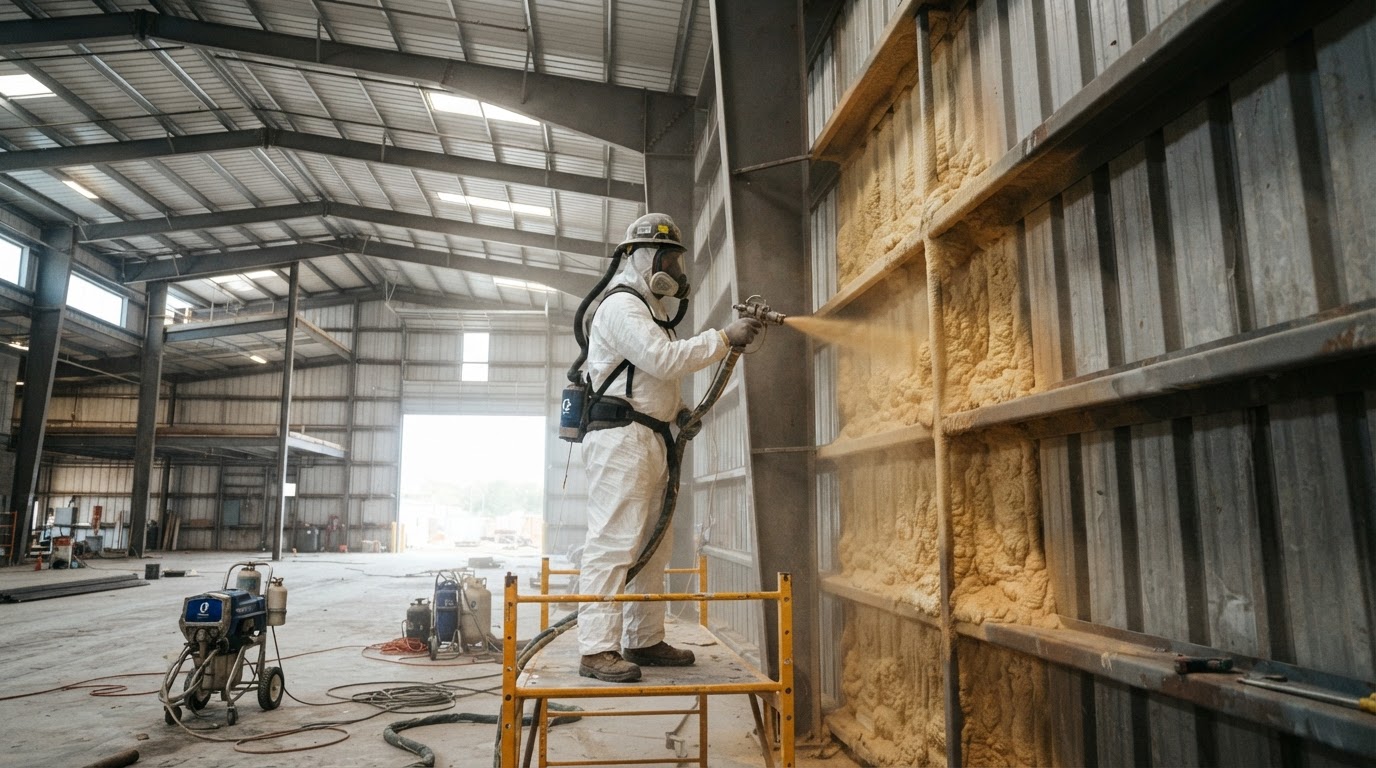
Spray foam, applied directly to the interior of the steel panels and purlins, creates a continuous layer that insulates and air seals in one application. Because it bonds to the metal, it helps separate interior air from the cold or hot steel surface, which is central to managing both heat transfer and condensation risk.
This service is for owners of metal shops, detached garages, storage buildings, agricultural steel structures, barndominiums with metal skins, and commercial metal buildings. The right approach depends on how the building is used, whether it is conditioned, and the interior finish plan — a building that will stay open storage has different needs from one that will be finished and heated or cooled.
Why use spray foam in a metal building?
Spray foam bonds directly to steel panels and purlins to insulate and air seal in one layer, which can help manage radiant heat and reduce condensation risk by separating interior air from the metal surface. The product, thickness, and condensation strategy must match the assembly and interior use.
Metal Building Benefits and Application Considerations
Metal buildings behave differently from wood-framed structures. These are the considerations behind a metal-building spray foam project in North Alabama.
Radiant heat control
A continuous foam layer on the steel can help reduce the radiant heat an uninsulated metal roof pours into the space during Huntsville summers.
Condensation considerations
Condensation control depends on assembly design, indoor and outdoor conditions, foam selection, thickness, air leakage, and other moisture sources — spray foam helps but does not universally eliminate condensation.
Direct-to-steel bonding
Closed-cell foam bonds directly to corrugated steel and purlins, creating a continuous layer without the gaps air can move behind.
Interior finish planning
Whether the building will stay open or be finished affects product and thickness — a building headed for conditioned, finished use is specified differently than open storage.
Closed Cell vs. Open Cell for Metal Buildings
For metal buildings, the open-cell vs. closed-cell decision leans strongly one way, with reasons tied to the steel substrate and condensation.
Closed-cell spray foam is the common choice for metal building walls and roofs because it bonds to steel, offers a high approximate R-value per inch, and has lower vapor permeance at sufficient thickness — all relevant where condensation control is a concern. Open-cell foam is vapor permeable and generally not the first choice for direct application to metal panels where the goal includes managing condensation.
That said, the right thickness and product still depend on the assembly, interior use, and condensation strategy. We do not assume one thickness works for every metal building; the goal is to match the foam to the structure and the conditions it must perform under.
Closed-cell on steel
Typically applied directly to corrugated steel and purlins for high R-value per inch, low permeance, and condensation management.
Open-cell in framed areas
May be considered for interior framed partitions in a finished metal building where vapor permeability suits the assembly.
Planning a Metal Building Spray Foam Project
Metal building projects center on the building's use and the condensation strategy. Here is how we approach it.
Review building use
We discuss whether the building is open storage, a conditioned shop, a finished barndominium, or commercial space, because that drives the specification.
Assess panels and access
We inspect the interior steel panels, purlins, roof condition, and access, and note any existing insulation or moisture issues.
Plan the condensation strategy
We consider indoor and outdoor conditions, air leakage, and other moisture sources alongside foam selection and thickness.
Prepare, apply, and verify
We mask contents, confirm the steel is clean and dry, apply closed-cell foam to the panels and roof, and verify coverage before cleanup.
Related Spray Foam Services
Huntsville-area metal buildings range from small detached garages to large commercial steel shells, so use, conditioning, and interior finish plans vary widely and drive the specification.
Metal Building Spray Foam FAQs for Huntsville Owners
Questions from owners of steel shops, garages, and storage buildings in Huntsville and the Tennessee Valley.
Is spray foam good for a metal building?
Open-cell or closed-cell for metal walls?
Can spray foam go directly on metal panels?
Does spray foam help with condensation?
Can an existing metal shop be insulated?
How much does metal building spray foam cost in Huntsville?
Discuss Your Metal Building Spray Foam Project
For steel shops, garages, storage buildings, and commercial metal buildings in Huntsville and the Tennessee Valley, Huntsville Spray Foam Installation can evaluate your structure and recommend an appropriate condensation and insulation strategy. Call (256) 361-1406 or request an estimate.