
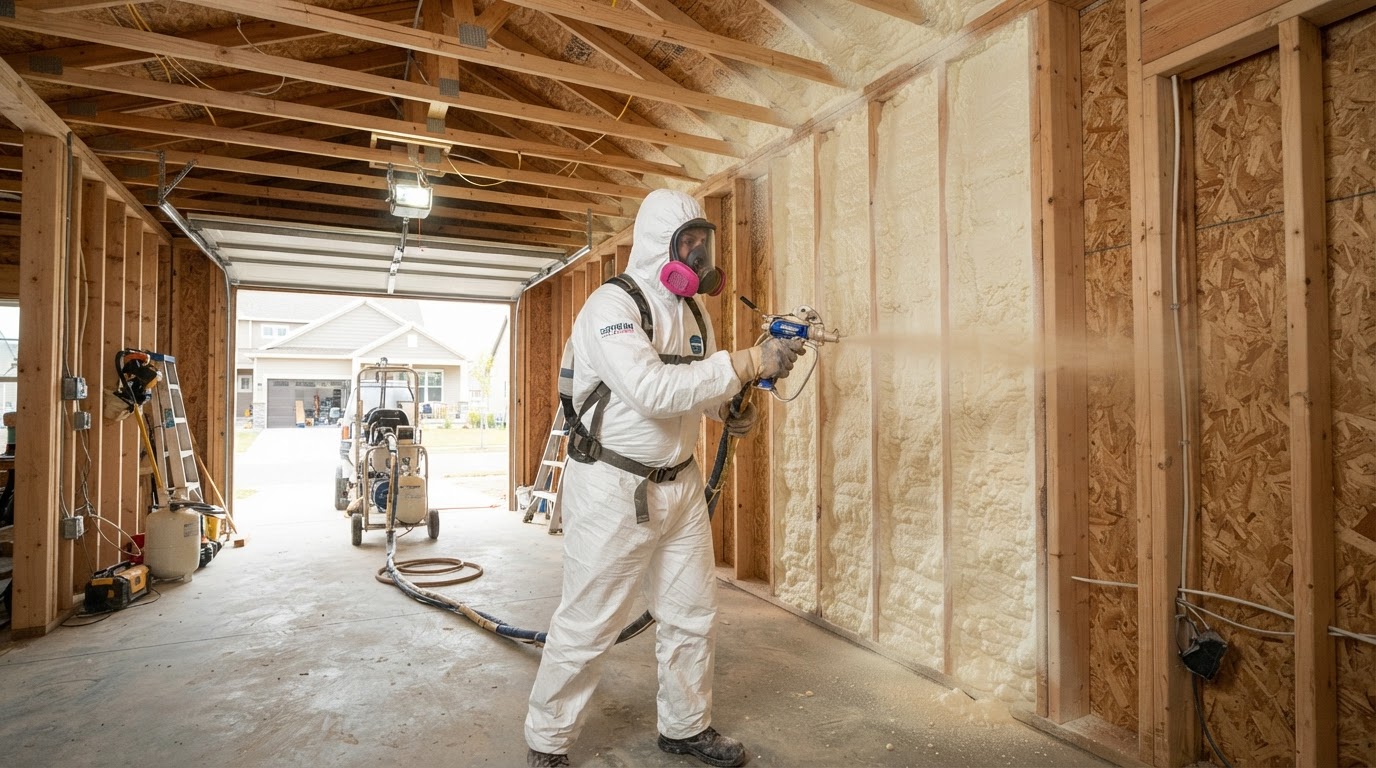
Garage Spray Foam Insulation in Huntsville, AL
Garage spray foam insulation applies spray polyurethane foam to the walls and ceiling of an attached or detached garage to insulate and air seal the space. For property owners in Huntsville, Alabama, it can help make a garage easier to heat and cool when the product matches the construction — but spray foam does not replace required ventilation, and it does not make a garage suitable for living or sleeping occupancy.
Huntsville Spray Foam Installation insulates attached garages, detached garages, metal garages, and bonus-room ceilings across Huntsville and North Alabama. A garage is its own building assembly: it is not a living room and not a full workshop, and the right approach depends on whether the garage shares a wall with the house, whether it is wood-framed or metal, and how the owner actually uses the space.
Request an Insulation Estimate
Tell us about your garage spray foam insulation project.
What Garages Can Use Spray Foam Insulation
Spray foam works for several garage configurations common in the Huntsville area: attached garages that share a wall or ceiling with conditioned living space, detached wood-framed garages, metal garages and metal carports with enclosed walls, and garages that double as hobby or workshop spaces. Each configuration has a different priority. An attached garage is often insulated to reduce the transfer of hot, humid outdoor air into the home through the shared wall and ceiling. A detached garage is usually insulated because the owner wants to heat or cool the space for a specific use.
The value in a garage is air sealing. Garages are notoriously leaky — large doors, gaps around framing, and unsealed ceiling penetrations let conditioned air escape and outside air in. Spray foam conforms to the framing and seals those gaps in a single application, which is what allows a small heater or mini-split to keep a garage comfortable instead of fighting constant air leakage.
An important boundary: insulating a garage does not change what the space is permitted or safe to use for. A garage used for vehicle storage, running engines, combustion equipment, or chemical storage may need separate ventilation for exhaust, fumes, and safety. Spray foam does not handle those requirements, and we will not imply that it does.
Is spray foam good for a garage?
Spray foam can be a good fit for many attached and detached garages in Huntsville when the goal is insulation and air sealing. It helps reduce air leakage through the garage envelope, but it does not replace required ventilation for vehicles, combustion equipment, or chemicals, and it does not make a garage suitable for sleeping or living occupancy.
Garage Insulation Benefits and Application Considerations
Garages present a specific set of demands around shared-wall separation, comfort, and air sealing. These are the considerations behind a garage spray foam project.
Shared-wall separation
In an attached garage, spray foam on the shared wall and ceiling can help reduce the movement of garage air, heat, and humidity into the living space behind it.
Easier heating and cooling
By air sealing the garage shell, spray foam can help a modest heater or mini-split keep a detached or conditioned garage comfortable without fighting constant air leakage.
Bonus-room ceilings
When a finished room sits above a garage, insulating the garage ceiling can help separate the conditioned room from the unconditioned garage below.
Metal garage assemblies
Metal garages can be spray foamed when the product and substrate are appropriate, helping insulate the metal skin and reduce temperature swings inside the enclosure.
Open Cell vs. Closed Cell Spray Foam for Garages
The right foam for a garage depends on whether the garage is wood-framed or metal, whether it is attached or detached, and how the owner uses the space. Open-cell and closed-cell are different products with different characteristics, and neither is universally correct for every garage.
Open-cell spray foam is a lower-density product that expands significantly and is commonly used in suitable framed, interior applications. In a wood-framed garage with open studs, open-cell can fill wall and ceiling cavities and provide air sealing in one application. Its vapor permeability is higher than closed-cell, so it is generally not the right choice where a vapor-resistant layer is the objective.
Closed-cell spray foam is denser, offers a higher approximate R-value per inch than typical open-cell products, and has lower vapor permeance at appropriate product-specific thicknesses. For metal garages, or where a more vapor-resistant assembly is desired, closed-cell is frequently evaluated. Product and thickness requirements vary, and the appropriate choice depends on the substrate, the assembly, and the project goals.
Neither product makes a garage waterproof, and neither eliminates the need for proper ventilation where vehicles, engines, or chemicals are present. Selection should be based on the actual building assembly, not on a one-size-fits-all rule.
| Consideration | Open-Cell Foam | Closed-Cell Foam |
|---|---|---|
| Typical garage use | Wood-framed walls and ceilings | Metal garages, vapor-sensitive assemblies |
| Density | Lower density, high expansion | Denser, higher R-value per inch |
| Vapor behavior | More vapor permeable | Lower vapor permeance at proper thickness |
| Air sealing | Yes, in suitable framed cavities | Yes, across suitable substrates |
Planning a Garage Spray Foam Project in Huntsville
A garage project is planned around the building type, the shared-wall relationship, and how the space is used. These are the typical stages, though actual requirements vary by property.
Discuss the garage and its use
We review whether the garage is attached or detached, wood-framed or metal, and how the owner uses the space — vehicle storage, hobby use, or conditioned workspace.
Review access and shared walls
For attached garages, we look at the shared wall and ceiling with the home. For detached garages, we review wall and roof access and any existing insulation.
Determine the foam and application
Based on the assembly, we discuss whether open-cell or closed-cell is more appropriate and the target areas — walls, ceiling, or shared surfaces.
Prepare and apply
The work area is prepared, spray polyurethane foam is applied to the intended assembly, and the work area is reviewed and cleaned.
Related Spray Foam Services
Huntsville Spray Foam Installation serves garage projects in Huntsville and surrounding North Alabama communities. Call (256) 361-1406 to discuss your garage and how you plan to use it.
Garage Spray Foam Insulation FAQs for Huntsville Property Owners
Common questions about insulating attached and detached garages with spray foam in the Huntsville area.
Is spray foam good for a garage?
Can a detached garage be spray foamed?
Can spray foam be applied to a metal garage?
Open-cell or closed-cell for a garage?
Can spray foam help make a garage easier to heat and cool?
How much does garage spray foam insulation cost in Huntsville?
Discuss Your Garage Spray Foam Project
Whether you have an attached garage, a detached shop-garage, or a metal garage you want to condition, Huntsville Spray Foam Installation can review the assembly and discuss a suitable approach. Call (256) 361-1406 or request an estimate to talk through your project.