Agricultural Building Spray Foam Insulation in Huntsville, AL
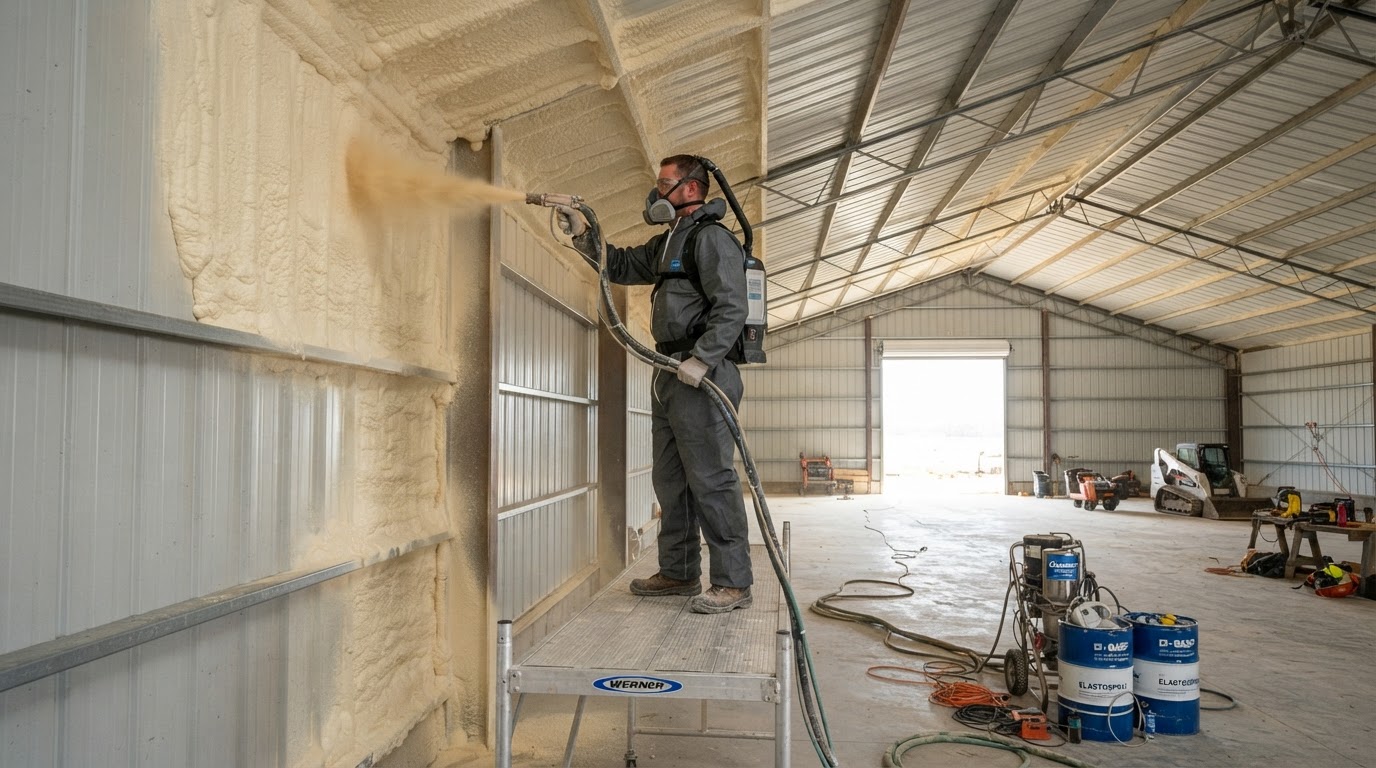
Agricultural building spray foam insulation applies spray polyurethane foam to the walls and roof of farm shops, equipment storage buildings, machinery buildings, and post-frame agricultural structures to insulate and air seal the envelope. For property owners in Huntsville and North Alabama, it can help make a conditioned ag building easier to heat and cool — but not every agricultural building needs conditioning, and spray foam does not make a building suitable for animals, food storage, chemicals, or grain without project-specific requirements.
Huntsville Spray Foam Installation insulates agricultural buildings across Huntsville and the surrounding Tennessee Valley, from farm shops and equipment storage to post-frame machinery buildings. Agricultural structures are a distinct category: they are large, often metal-skinned, and used for purposes that range from unconditioned storage to fully conditioned workspaces. The insulation strategy follows the use of the building.
Request an Insulation Estimate
Tell us about your agricultural building spray foam insulation project.
Agricultural Buildings That Can Use Spray Foam
Spray foam fits a range of agricultural structures common in North Alabama: farm shops where equipment is repaired and maintained, equipment and machinery storage buildings, agricultural metal buildings, post-frame structures, and pole barns used as conditioned work areas. The common thread is a large envelope where the owner wants either full conditioning or a more stable interior environment.
Not every agricultural building needs insulation. An open equipment shed used only to keep rain off machinery may not require spray foam, while a farm shop that is heated and cooled for year-round work usually benefits from an insulated, air-sealed envelope. The decision starts with how the building is used.
An important boundary: spray foam does not make an agricultural building suitable for specialized uses — animals, food storage, grain, chemicals, or sanitary agricultural processing — without project-specific requirements. Material selection, protective coverings, fire and code considerations, and agricultural operating conditions all affect what is appropriate for a given building.
Can agricultural buildings be spray foamed?
Yes. Farm shops, equipment storage buildings, machinery buildings, agricultural metal buildings, and post-frame structures can be spray foamed when the product and application are appropriate. Not every ag building needs conditioning, and spray foam does not make a building suitable for animals, food, chemicals, or grain without project-specific requirements.
Agricultural Building Benefits and Application Considerations
Agricultural buildings are large envelopes with specific demands around temperature, condensation, and use. These are the considerations behind an ag-building spray foam project.
Conditioned farm shops
In a heated and cooled farm shop, spray foam helps air seal the large envelope so a modest HVAC system can maintain comfort without fighting constant air leakage.
Metal wall and roof assemblies
Agricultural metal buildings can be spray foamed when the product and substrate are appropriate, helping insulate the metal skin and reduce interior temperature swings.
Condensation considerations
Metal ag buildings can experience condensation when warm, humid air meets cool metal. Spray foam may help, but condensation control depends on assembly design, conditions, foam selection, thickness, and moisture sources.
Future interior finishes
Whether the building will receive interior walls or ceilings affects the insulation plan. Spray foam is often applied before interior finishes are installed.
Open Cell vs. Closed Cell for Agricultural Buildings
Agricultural buildings are often metal-skinned and large, which shapes the foam choice. Open-cell and closed-cell behave differently on metal assemblies, and neither is universally required.
Open-cell spray foam is a lower-density, high-expansion product. It is sometimes used in framed agricultural wall and roof assemblies where air sealing and cavity fill are the objectives. Its higher vapor permeability means it is generally not chosen where a vapor-resistant layer against metal is the goal.
Closed-cell spray foam is denser, offers a higher approximate R-value per inch, and has lower vapor permeance at appropriate product-specific thicknesses. For metal agricultural buildings, closed-cell is frequently evaluated because it bonds to metal panels and provides a more vapor-resistant layer. It is commonly discussed for metal walls and roofs, but it is not universally required for every ag building.
Condensation is a real concern in metal agricultural structures, but spray foam does not automatically eliminate all condensation. Condensation control depends on assembly design, indoor and outdoor conditions, foam selection, thickness, air leakage, and moisture sources. The right approach is based on the specific building and how it is used.
| Ag building factor | Open-Cell | Closed-Cell |
|---|---|---|
| Metal assemblies | Less common on bare metal | Frequently evaluated for metal |
| Density / R-value | Lower density, lower R per inch | Denser, higher R per inch |
| Vapor resistance | More permeable | Lower permeance at proper thickness |
| Typical use | Framed ag wall/roof cavities | Metal walls, roofs, vapor-sensitive areas |
Planning an Agricultural Building Project
An agricultural project is planned around the building type, its metal or framed construction, and how it is used. These are the typical stages, though requirements vary by structure.
Discuss the building and its use
We review whether the building is a farm shop, equipment storage, or machinery building, whether it is metal or framed, and whether it will be conditioned.
Review the envelope and access
We look at wall and roof assemblies, metal panel condition, interior contents, and whether interior finishes are planned.
Determine the foam and application
Based on the assembly and use, we discuss open-cell or closed-cell and the target areas — walls, roof, or both.
Prepare and apply
The work area is prepared, spray polyurethane foam is applied to the intended assemblies, and the work area is reviewed and cleaned.
Related Spray Foam Services
Huntsville Spray Foam Installation serves agricultural building projects in Huntsville and across North Alabama. Call (256) 361-1406 to discuss your farm shop or equipment building.
Agricultural Building Spray Foam FAQs
Common questions about insulating agricultural buildings with spray foam in the Huntsville area.
Can agricultural buildings be spray foamed?
Can spray foam be applied to a metal farm building?
Is spray foam useful for equipment storage buildings?
Open-cell or closed-cell for an agricultural building?
Does spray foam eliminate condensation?
What affects farm-building spray foam pricing?
Discuss Your Agricultural Building Spray Foam Project
Whether you have a farm shop, equipment storage building, or post-frame ag structure, Huntsville Spray Foam Installation can review the envelope and discuss a suitable approach. Call (256) 361-1406 or request an estimate to talk through your agricultural building.