Poultry House & Chicken House Spray Foam Insulation Near Huntsville, AL
Poultry house spray foam insulation applies spray polyurethane foam to the walls and roof of a poultry or chicken-house structure to insulate and air seal the building envelope. For agricultural property owners near Huntsville, Alabama, it is a building-envelope service — it does not guarantee animal-welfare, production, feed-conversion, mortality, sanitation, or biosecurity outcomes, and material selection and protective coverings depend on building use, exposure, fire and code requirements, and agricultural operating conditions.
Huntsville Spray Foam Installation insulates poultry-house envelopes across Huntsville and the surrounding North Alabama and Tennessee Valley region. Poultry houses are long, large-envelope agricultural buildings, and the insulation discussion here is strictly about the building shell — the walls, roof, and air-sealing characteristics of the structure itself, not the agricultural production that happens inside it.
Request an Insulation Estimate
Tell us about your poultry house & chicken house spray foam insulation project.
What Poultry House Spray Foam Addresses
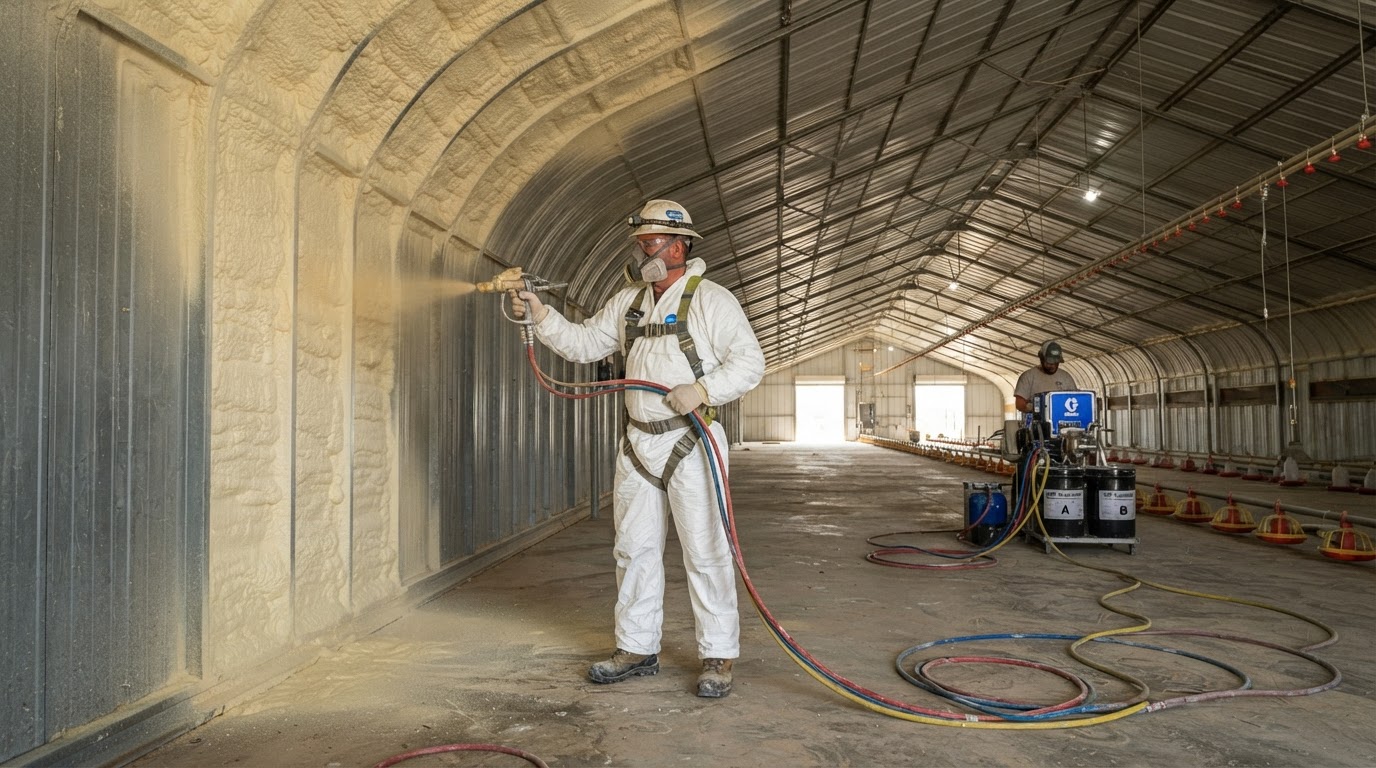
Poultry and chicken houses are long agricultural buildings with metal wall and roof components and a large interior envelope. Spray foam can be applied to suitable wall and roof assemblies to insulate and air seal the shell, which may help reduce uncontrolled air movement through the envelope. The discussion is about the building envelope, not the birds.
Existing versus new structures matters. New poultry construction allows spray foam to be applied before interior systems are in place, while existing poultry buildings may be retrofit candidates where panels and framing are accessible. The condition of the existing envelope, any prior insulation, and the interior environment all affect what is realistic.
A critical boundary: spray foam is a building material, not an agricultural production system. We do not claim that insulating a poultry house guarantees lower mortality, faster growth, better feed conversion, increased egg production, or any other flock-performance outcome. Those depend on ventilation, heating, management, genetics, nutrition, and many factors outside insulation.
Can a poultry house be insulated with spray foam?
Yes, the walls and roof of a poultry or chicken-house structure can be insulated with spray foam when the product and application are appropriate for the assembly. It is a building-envelope service that insulates and air seals the shell. It does not guarantee animal-welfare, production, sanitation, or biosecurity outcomes.
Poultry House Envelope Considerations
Poultry houses have specific envelope demands related to their long span, metal components, and interior environment. These are the considerations behind a poultry-house spray foam project.
Long building envelope
Poultry houses are long structures with extensive wall and roof area, so air sealing the envelope can help reduce uncontrolled air movement along the full length of the building.
Metal wall and roof assemblies
Metal panels are common in poultry construction. Spray foam can be applied to suitable metal assemblies when the product, substrate, and application are appropriate.
Washdown and moisture exposure
Poultry buildings are washed down and exposed to moisture. Material selection and protective coverings may depend on this exposure, fire and code requirements, and agricultural operating conditions.
Interior environmental demands
The interior environment of a poultry house is managed by ventilation and heating systems. Spray foam addresses the envelope, not those mechanical and management systems.
Product Selection and Protective Coverings for Poultry Houses
Poultry houses demand careful product selection because of moisture exposure, washdown, fire and code requirements, and agricultural operating conditions. The foam choice and any required coverings depend on the specific building and its use.
Closed-cell spray foam is frequently evaluated for poultry-house metal assemblies because of its density, higher approximate R-value per inch, and lower vapor permeance at appropriate product-specific thicknesses. It bonds to metal panels and provides a more vapor-resistant layer, which is often relevant in moisture-exposed agricultural envelopes. It is not universally required, and the choice depends on the assembly.
Open-cell spray foam is a lower-density, high-expansion product. It is generally less common on bare metal poultry-house panels because of its higher vapor permeability, but it may be considered in specific framed assemblies. Neither product is universally appropriate for every poultry building.
Protective coverings and material selection may be required depending on building use, exposure, fire and code requirements, and agricultural operating conditions. Spray foam does not itself satisfy agricultural sanitation requirements, and exposed foam may need a thermal or ignition barrier covering where codes or operating conditions require it. These decisions are project-specific.
| Poultry factor | Open-Cell | Closed-Cell |
|---|---|---|
| Metal panels | Less common on bare metal | Frequently evaluated for metal |
| Moisture exposure | More permeable, less resistant | Lower permeance, denser |
| Vapor behavior | Allows more vapor movement | More vapor-resistant at proper thickness |
| Coverings | May require covering per code/use | May require covering per code/use |
Planning a Poultry House Insulation Project
A poultry-house project is planned around the building envelope, the metal or framed construction, and the operating conditions. These are the typical stages, though requirements vary by structure.
Discuss the building and its use
We review whether the poultry house is new or existing, its metal or framed construction, and the operating conditions including washdown and moisture exposure.
Review the envelope and access
We look at wall and roof assemblies, metal panel condition, any prior insulation, and accessibility along the length of the building.
Determine product and coverings
Based on the assembly and use, we discuss open-cell or closed-cell, target areas, and whether protective coverings are needed for fire, code, or operating reasons.
Prepare and apply
The work area is prepared, spray polyurethane foam is applied to the intended assemblies, coverings are addressed where required, and the work area is reviewed.
Related Spray Foam Services
Huntsville Spray Foam Installation serves poultry-house envelope projects near Huntsville and across the North Alabama and Tennessee Valley region. Call (256) 361-1406 to discuss your poultry building.
Poultry House Spray Foam FAQs
Common questions about insulating poultry and chicken-house envelopes with spray foam near Huntsville.
Can a poultry house be insulated with spray foam?
Can spray foam be applied to poultry-house metal panels?
Is closed-cell foam considered for chicken houses?
Does spray foam eliminate poultry-house condensation?
Can existing poultry buildings be retrofitted?
What factors determine poultry-house insulation cost?
Discuss Your Poultry House Envelope Project
If you need to insulate a poultry or chicken-house envelope near Huntsville, Huntsville Spray Foam Installation can review the building and discuss a suitable product and covering approach. Call (256) 361-1406 or request an estimate to talk through your poultry building.