
Cathedral & Vaulted Ceiling Spray Foam Insulation in Huntsville, AL
Cathedral and vaulted ceiling spray foam insulation applies spray polyurethane foam to the sloped roof rafters and ceiling cavities of a vaulted or cathedral assembly, where there is often no full attic above. Huntsville Spray Foam Installation evaluates the rafter depth, ventilation strategy, roof-deck condition, and whether the assembly is open before finish installation before recommending an approach, because cathedral ceilings behave differently from a conventional vented attic.
Homes in Huntsville and North Alabama with cathedral and vaulted ceilings have a unique insulation challenge: the ceiling follows the roofline, leaving little or no attic space above. That means the insulation must fit within the rafter cavity, and the ventilation and vapor strategy matter more than in a flat-ceiling attic. Spray foam is often considered for these assemblies, but the approach depends on the specific roof and whether framing is exposed.
Request an Insulation Estimate
Tell us about your cathedral & vaulted ceiling spray foam insulation project.
What Makes Cathedral & Vaulted Ceilings Different
A cathedral or vaulted ceiling is one where the interior ceiling surface follows the slope of the roof, so the insulation lives in the rafter cavity directly under the roof sheathing rather than on a flat attic floor. The available cavity depth is limited by the rafter size, which constrains how much insulation can fit and the total R-value that can be achieved. This is fundamentally different from a conventional attic, where insulation sits on the floor and a large vented space sits above it.
Because the cavity is shallow and bounded by the roof deck, air leakage, thermal continuity, and moisture all behave differently. A poorly insulated cathedral ceiling can conduct significant heat through the roof in summer and lose heat in winter, and any air leakage path through the assembly can move moist air into the roof structure. Spray foam is often considered because it fills the cavity and air seals in one application, which is valuable where depth is limited.
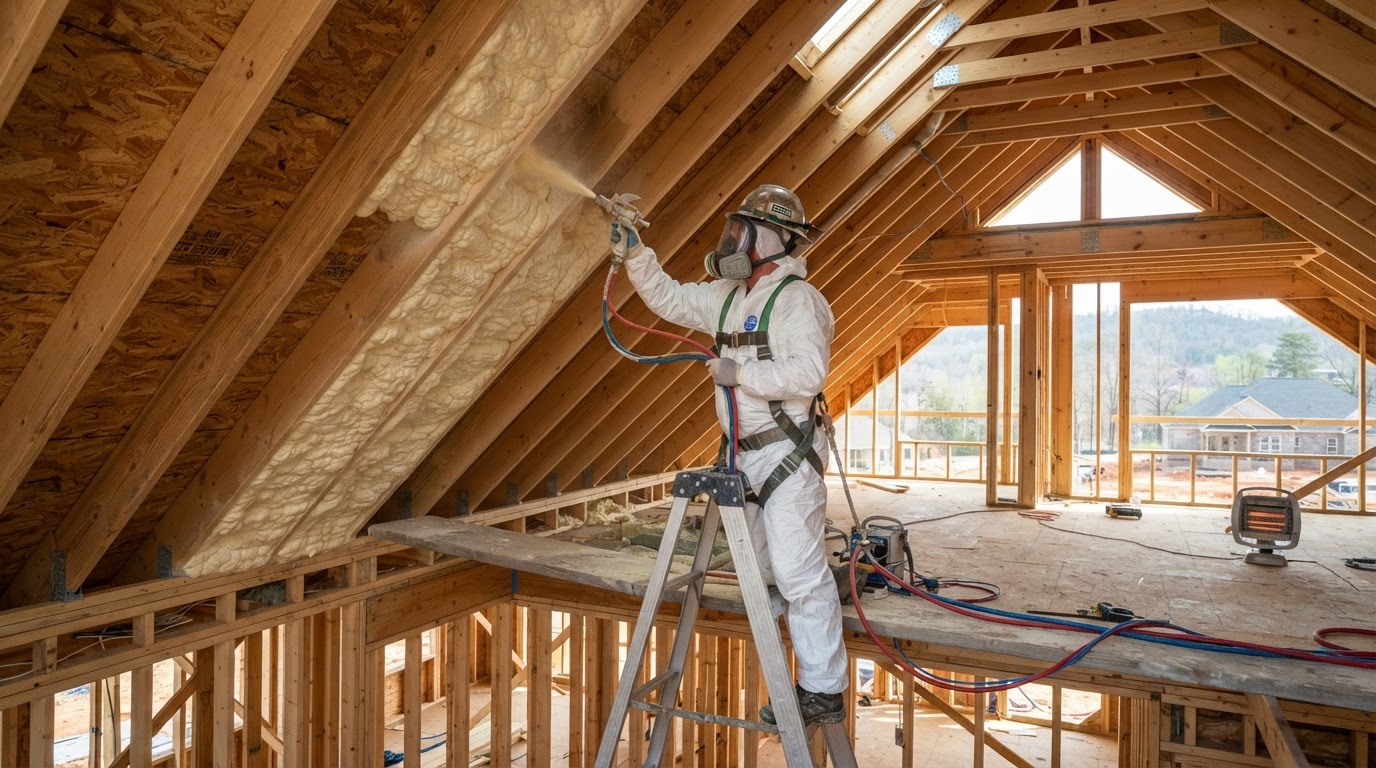
New construction and renovation are the two common situations. In new construction, the rafters are exposed before the ceiling finish is installed, which is the easiest time to insulate. In renovation, an existing finished vaulted ceiling generally cannot be insulated without opening the assembly to access the rafter cavities, which is a much larger project. We do not state that spray foam can simply be added behind every finished ceiling without opening it.
Can spray foam be used in a cathedral ceiling?
Yes. Spray foam can be applied between roof rafters in a cathedral or vaulted ceiling when framing is exposed, such as during new construction or renovation. It fills the limited rafter cavity and air seals in one application. The approach depends on rafter depth, ventilation strategy, and roof-deck condition, and finished vaulted ceilings generally must be opened to access the cavity.
Problems Cathedral & Vaulted Ceiling Spray Foam Addresses
The shallow, roof-bounded nature of a vaulted ceiling creates specific issues. These are the ones a spray foam application is meant to help address.
Limited cavity depth
Rafters are shallower than an attic is deep, so R-value per inch matters. Spray foam's higher per-inch performance can help where depth is constrained.
Roofline air leakage
Air moving through a vaulted ceiling assembly carries heat and moisture into the roof structure. Foam seals the cavity to reduce that movement.
Thermal continuity
A sloped ceiling needs continuous insulation along the roofline. Foam conforms to the rafter cavity to help maintain that continuity without gaps.
Penetrations and lighting
Recessed lights and electrical in a vaulted ceiling create penetration paths. Foam seals around these where accessible, though fixtures must be suitable for the assembly.
Open Cell vs. Closed Cell for Vaulted Ceilings
Cathedral ceiling assemblies require a real discussion of ventilation and vapor strategy, not a one-size-fits-all product choice.
Open-cell spray foam is often considered for cathedral ceilings because it expands to fill the rafter cavity and provides air sealing at typical framing depths. Its higher vapor permeability can allow the assembly to dry inward in some strategies, which matters for roof assemblies. Open-cell is a common choice for interior roofline applications where the assembly is designed to manage vapor through permeability.
Closed-cell spray foam is denser and offers a higher approximate R-value per inch, which is valuable where rafter depth is limited. Its lower vapor permeance at appropriate product-specific thicknesses can be relevant for certain roof assemblies. Closed-cell is sometimes selected where cavity depth is very shallow and maximum R-value per inch is needed, but it is not universally required.
Ventilation is a key question. We do not claim every cathedral ceiling should be unvented, and we do not tell visitors to block ventilation without a project-specific evaluation. Whether a vaulted assembly should be vented or unvented depends on the roof design, climate, product specifications, and applicable code. The foam choice and the ventilation strategy must be considered together for the specific assembly.
| Vaulted ceiling factor | Open-Cell | Closed-Cell |
|---|---|---|
| Cavity fill | High expansion fills rafter cavity | Fills cavity at higher density |
| R-value per inch | Lower (product-dependent) | Higher (product-dependent) |
| Vapor behavior | More permeable, can dry inward | Lower permeance at proper thickness |
| Common use | Interior roofline applications | Shallow cavities, max R per inch |
Planning a Cathedral Ceiling Project in Huntsville
A vaulted ceiling project is planned around the assembly type, whether framing is exposed, and the ventilation and vapor strategy for the roof.
Identify the assembly type
We determine whether the ceiling is a new-construction exposed rafter assembly or a finished ceiling that would need to be opened, and review rafter depth.
Confirm access
We confirm whether the rafter cavities are reachable. Finished vaulted ceilings generally require opening the assembly to access the cavity.
Review ventilation strategy
We discuss whether the assembly is vented or unvented based on the roof design, climate, and applicable code. We do not prescribe one ventilation design universally.
Select foam and apply before finish
Open-cell or closed-cell is selected based on the assembly, and foam is applied before the interior ceiling finish is installed.
Related Spray Foam Services
Huntsville Spray Foam Installation evaluates cathedral and vaulted ceiling assemblies in Huntsville and North Alabama on a project-by-project basis, reviewing rafter depth, access, and ventilation strategy before recommending an approach.
Cathedral & Vaulted Ceiling Spray Foam FAQs
Common questions about insulating cathedral and vaulted ceilings with spray foam in the Huntsville area.
Can spray foam be used in a cathedral ceiling?
Is a vaulted ceiling different from a normal attic?
Can spray foam go between roof rafters?
Open-cell or closed-cell for vaulted ceilings?
Does a cathedral ceiling need ventilation?
Can existing finished vaulted ceilings be retrofitted?
What affects cathedral-ceiling spray foam cost?
Discuss Your Cathedral or Vaulted Ceiling Project
If you are planning insulation for a cathedral or vaulted ceiling, Huntsville Spray Foam Installation can review the rafter depth, access, and ventilation strategy. Call (256) 361-1406 or request an estimate to talk through your vaulted ceiling project.