
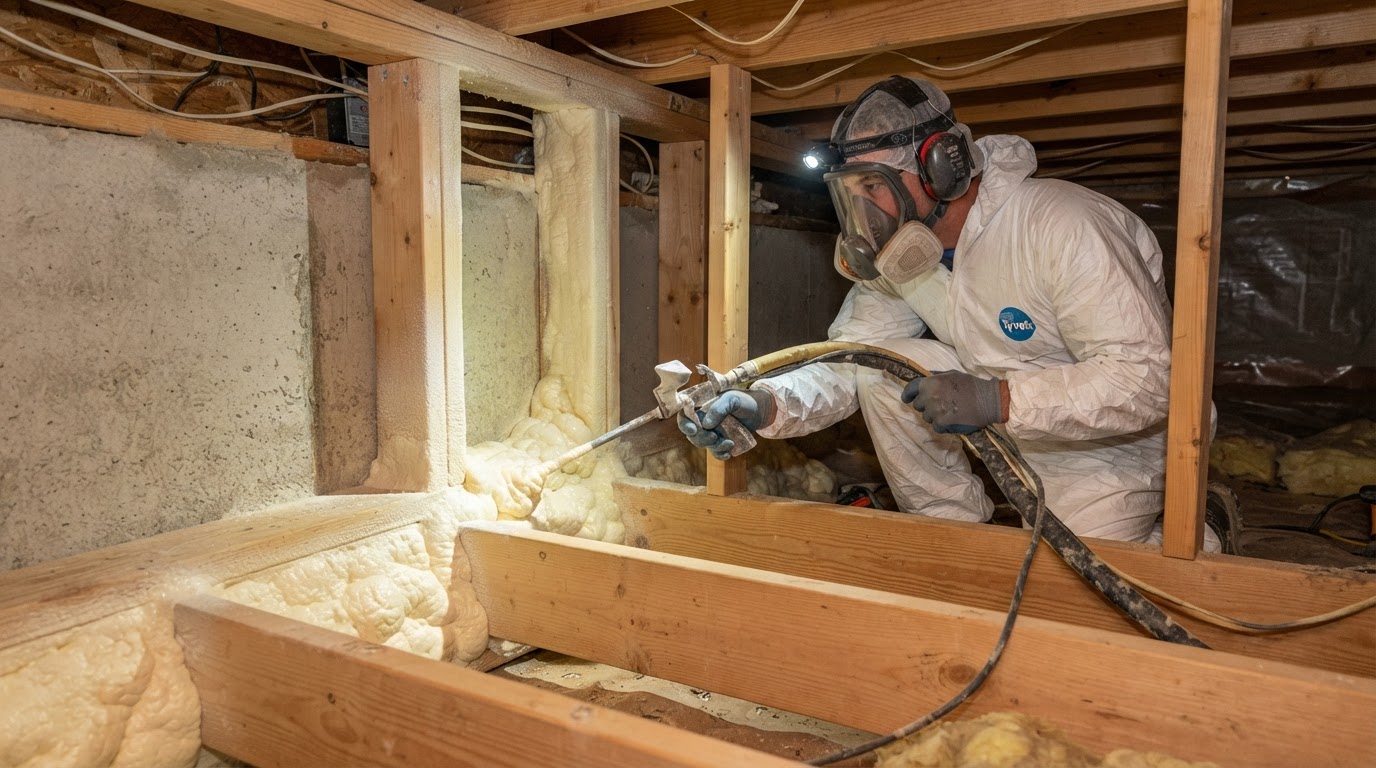
Rim Joist Spray Foam Insulation in Huntsville, AL
Rim joist spray foam insulation applies spray polyurethane foam to the rim joist — also called the band joist — the wood framing member that runs around the perimeter of the floor frame where the floor meets the foundation. For homeowners in Huntsville, Alabama, insulating and air sealing this area can help reduce air leakage at a common gap in the building envelope, but spray foam does not automatically fix moisture-damaged wood, and wet or damaged rim joists should not be covered until moisture sources are corrected.
Huntsville Spray Foam Installation air seals rim joists across Huntsville and North Alabama. The rim joist is one of the most common air-leakage points in a home — it is the perimeter band where floor framing sits on the foundation, and it is frequently left unsealed or stuffed with fiberglass that does not stop air movement. This page is distinct from the general crawl-space service: it focuses specifically on the rim-joist assembly.
Request an Insulation Estimate
Tell us about your rim joist spray foam insulation project.
What a Rim Joist Is and Why It Leaks
A rim joist — also called a band joist — is the wood framing member that caps the ends of the floor joists and runs around the perimeter of the floor frame, sitting on top of the foundation wall. It is the transition between the foundation and the wood floor system. In crawl-space and basement construction, the rim joist is the vertical band you see where the floor framing meets the foundation.
The rim joist is a major air-leakage point because it is where two different materials — concrete foundation and wood framing — meet, and it is full of penetrations, gaps, and utility openings. In many homes, the rim joist is either left uninsulated or stuffed with fiberglass batt, which does not air seal. Fiberglass in a rim-joist cavity can also trap moisture against the wood, which is why retrofitting rim joists with spray foam is a common envelope project.
Spray foam is valued at the rim joist because it both insulates and air seals in one application. It conforms to the rim joist, the sill plate, and any utility penetrations, closing the gaps that let outside air, humidity, and pests into the floor framing. This is the core benefit of a rim-joist project: turning a leaky perimeter into a sealed boundary.
What is a rim joist?
A rim joist, or band joist, is the wood framing member that runs around the perimeter of the floor frame, capping the ends of the floor joists where the floor meets the foundation. It is a major air-leakage point in many homes because it sits at the transition between the foundation and the wood floor system and is often left unsealed.
Rim Joist Benefits and Moisture Considerations
Rim joist spray foam is valued for air sealing and perimeter insulation, but moisture is a critical consideration. These are the factors behind a rim-joist project.
Air sealing the perimeter
Spray foam air seals the rim joist, sill plate, and utility penetrations, closing one of the most common envelope gaps in a home.
Crawl-space and basement rim
Rim joists appear in both crawl-space and basement construction. In a crawl space, the rim area is often accessible; in a basement, it sits at the top of the foundation wall.
Utility penetrations
Plumbing, electrical, and HVAC penetrations often pass through the rim area. Spray foam conforms around these openings, reducing air movement.
Moisture inspection first
Wet or moisture-damaged wood should not be covered with foam until the moisture source is corrected. Spray foam does not fix active leaks, rot, or drainage problems.
Product Selection and Moisture Strategy at the Rim Joist
The rim joist is a moisture-sensitive assembly, so product and application selection matters. Open-cell and closed-cell behave differently at the rim, and existing insulation and wood condition are reviewed first.
Closed-cell spray foam is frequently evaluated for rim-joist applications because of its density, higher approximate R-value per inch, and lower vapor permeance at appropriate product-specific thicknesses. At the rim — where the foundation meets wood framing and humidity from the crawl space or basement is a concern — a more vapor-resistant layer is often desired. Closed-cell is commonly discussed for this reason, though it is not universally required.
Open-cell spray foam is a lower-density, high-expansion product. It is sometimes used at the rim in specific situations, but its higher vapor permeability means it is generally not the first choice where a vapor-resistant layer at a moisture-sensitive perimeter is the objective. The choice depends on the assembly, the moisture conditions, and the project goals.
Existing fiberglass or other insulation in the rim cavity is a key decision. Old fiberglass that is wet, compressed, or moldy may need removal before new foam is applied, because covering a wet or failed material can trap moisture against the wood. The rim joist and sill plate are inspected for rot, pest damage, or active leaks before any insulation work — spray foam does not fix moisture-damaged wood, and wet or damaged rim joists should not be covered until the moisture source is corrected.
| Rim joist factor | Open-Cell | Closed-Cell |
|---|---|---|
| Vapor resistance | More permeable | Lower permeance, more resistant |
| R-value per inch | Lower (approximate) | Higher (approximate, product-dependent) |
| Moisture sensitivity | Less ideal at wet rim | Frequently evaluated for rim |
| Existing fiberglass | May need removal first | May need removal first |
Rim Joist Planning and Related Services
A rim-joist project is planned around access, wood condition, and moisture. These are the typical stages, though requirements vary by home.
Discuss the home and access
We review whether the home has a crawl space or basement, and whether the rim area is accessible from inside or below.
Inspect wood condition and moisture
The rim joist and sill plate are inspected for rot, pest damage, and active moisture. Existing insulation is reviewed for removal or retention.
Identify moisture correction if needed
If there is active water intrusion, drainage issues, or leaks, those moisture sources may need separate correction before any insulation work proceeds.
Apply the foam and air seal
Spray polyurethane foam is applied to the rim joist, sill plate, and utility penetrations, and the work area is reviewed and cleaned.
Related Spray Foam Services
Huntsville Spray Foam Installation air seals rim joists in homes across Huntsville and North Alabama. Call (256) 361-1406 to discuss your crawl-space or basement rim area.
Rim Joist Spray Foam FAQs for Huntsville Homes
Common questions about insulating rim joists with spray foam in the Huntsville area.
What is a rim joist?
Can rim joists be insulated with spray foam?
Can spray foam help air-seal the band joist area?
Should existing fiberglass be removed?
Can wet or damaged rim joists be spray foamed?
How much does rim joist spray foam cost in Huntsville?
Air Seal Your Rim Joists With a Huntsville Spray Foam Contractor
If your home has a leaky rim joist, unsealed sill plate, or old fiberglass in the band-joist cavity, Huntsville Spray Foam Installation can inspect the wood condition and discuss an air-sealing approach. Call (256) 361-1406 or request an estimate to talk through your rim-joist project.