Existing Home & Retrofit Spray Foam Insulation in Huntsville, AL
Retrofit spray foam insulation adds spray polyurethane foam to an existing home where assemblies are accessible — most often attics, crawl spaces, rim areas, and wall cavities opened during remodeling. For homeowners in Huntsville, Alabama, the defining factor in a retrofit is access: spray foam cannot simply be applied into every closed, finished wall without opening surfaces or using an application specifically designed for that situation.
Huntsville Spray Foam Installation works on existing homes across Huntsville and North Alabama, from older houses being renovated to additions and remodels where framing is exposed. Retrofit work is different from new construction because the building is already finished, and the realistic options depend on which assemblies can be reached. We focus on where spray foam can actually be installed well rather than promising it everywhere.
Request an Insulation Estimate
Tell us about your existing home & retrofit spray foam insulation project.
Where Retrofit Spray Foam Fits in an Existing Home
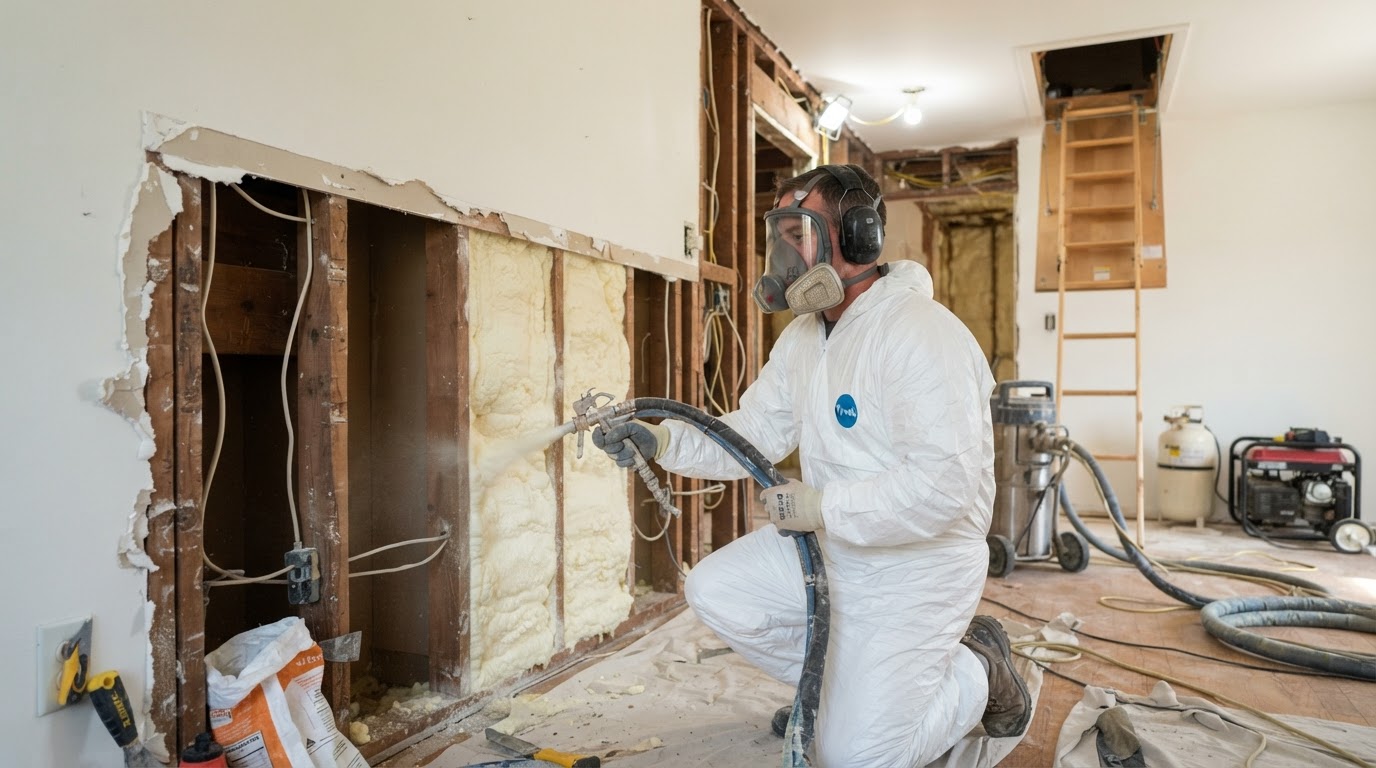
In an existing home, spray foam is most practical where there is access to the assembly. Attics are the most common retrofit target — an open attic with exposed roof rafters or an attic floor can often be spray foamed. Crawl spaces are another frequent retrofit, where rim joists, foundation walls, or the subfloor area can be reached. Additions and remodels that open walls create the opportunity to spray foam wall cavities while the framing is exposed.
What retrofit spray foam is not: a magic step that can be applied into every closed, finished wall without access. Conventional spray foam is not simply injected into sealed finished wall cavities without opening surfaces or using an application specifically designed for that situation. If walls are closed and finished, the realistic options are limited until those surfaces are opened during a remodel.
Existing insulation is a key consideration. Old attic insulation may be removed, left in place, or supplemented depending on its condition, type, and the project goals. We review what is already there before recommending an approach, because covering a wet, failed, or contaminated material with new foam is rarely the right move.
Can spray foam be added to an existing home?
Yes, spray foam can be added to an existing home where assemblies are accessible — typically attics, crawl spaces, rim areas, and wall cavities opened during remodeling. It is not simply sprayed into closed, finished walls without access. The realistic options depend on which areas can be reached and the condition of any existing insulation.
Retrofit Benefits and Access Considerations
Retrofit work is shaped by what can be reached. These are the considerations that drive an existing-home spray foam project.
Attic access
Open attics with exposed rafters or attic floors are the most accessible retrofit target and often the highest-impact area in an existing home.
Crawl space access
Crawl spaces allow retrofit spray foam at rim joists, foundation walls, or the subfloor where the area is reachable and conditions are suitable.
Remodel openings
When walls are opened during a renovation or addition, spray foam can be applied to the exposed framing before finishes go back up.
Existing insulation review
Old insulation is evaluated for condition and type before installation. Wet, failed, or contaminated material may need removal before new foam is applied.
Open Cell vs. Closed Cell for Accessible Retrofit Assemblies
In a retrofit, the foam choice is tied to the assembly that can actually be reached. Open-cell and closed-cell serve different retrofit situations, and the accessible area often determines which is appropriate.
Open-cell spray foam is commonly used in accessible attic rooflines and open wall cavities during remodels. Its high expansion helps fill irregular framing gaps in older homes, where studs and rafters are rarely perfectly uniform. Because it is more vapor permeable, it is generally used where a vapor-resistant layer is not the objective.
Closed-cell spray foam is denser, offers a higher approximate R-value per inch, and has lower vapor permeance at appropriate product-specific thicknesses. It is frequently evaluated for crawl-space rim areas, foundation walls, and other assemblies where a more vapor-resistant approach is desired. In tight retrofit spaces, its higher R-value per inch can be useful where depth is limited.
Moisture is a critical retrofit consideration. Existing homes often have hidden leaks, condensation, or drainage issues. Spray foam does not repair active water intrusion, and covering a wet or damaged assembly with foam can trap moisture. Moisture sources may need separate correction before any insulation work proceeds.
| Retrofit area | Open-Cell | Closed-Cell |
|---|---|---|
| Attic roofline | Commonly used | Used where vapor resistance is desired |
| Crawl space / rim | Less common | Frequently evaluated |
| Open wall cavities | Commonly used in remodels | Used where depth is limited |
| Vapor behavior | More permeable | Lower permeance at proper thickness |
Retrofit Planning and Related Services
A retrofit project starts with understanding what can be accessed. These are the typical stages, though every existing home is different.
Discuss the home and goals
We review the age of the home, what areas are uncomfortable or leaky, and whether any remodeling or additions are planned that would open assemblies.
Evaluate accessible areas
We look at attic access, crawl-space entry, and any open framing. Closed, finished walls are flagged as inaccessible until opened during a remodel.
Review existing insulation and moisture
Existing insulation is checked for condition. Any signs of active leaks, moisture, or damage are identified, since those may need separate correction first.
Plan and apply
Based on the accessible assemblies, we determine a suitable foam and application, prepare the area, apply the spray foam, and complete cleanup.
Related Spray Foam Services
Huntsville Spray Foam Installation evaluates existing homes throughout Huntsville and North Alabama. Call (256) 361-1406 to discuss which assemblies in your home are accessible for retrofit spray foam.
Retrofit Spray Foam FAQs for Existing Huntsville Homes
Common questions about adding spray foam insulation to existing homes in the Huntsville area.
Can spray foam be added to an existing home?
Do walls need to be opened for spray foam?
Should old attic insulation be removed?
Can crawl spaces in existing homes be spray foamed?
Can spray foam be installed during remodeling?
What affects retrofit spray foam cost?
Review Your Existing Home With a Spray Foam Contractor
If you own an existing home in Huntsville and want to understand where spray foam can realistically be installed, Huntsville Spray Foam Installation can evaluate your attic, crawl space, and any remodeling openings. Call (256) 361-1406 or request an estimate to discuss your retrofit project.