Steel Building Spray Foam Insulation in Huntsville, AL
Steel building spray foam insulation applies spray polyurethane foam to the walls and roof of a steel-frame or steel-panel building to insulate and air seal the envelope. For property owners in Huntsville, Alabama, it can help reduce temperature swings and air leakage in steel structures — but steel requires attention to substrate condition, surface preparation, condensation strategy, and fire-protection or covering considerations, and spray foam does not automatically eliminate all condensation.
Huntsville Spray Foam Installation insulates steel buildings across Huntsville and North Alabama, from steel-frame commercial buildings and steel shops to steel warehouses and steel storage buildings. This page is distinct from the broader metal building service: it focuses specifically on steel structural systems and steel-panel assemblies, where substrate, preparation, and condensation strategy matter most.
Request an Insulation Estimate
Tell us about your steel building spray foam insulation project.
Steel Buildings That Can Use Spray Foam
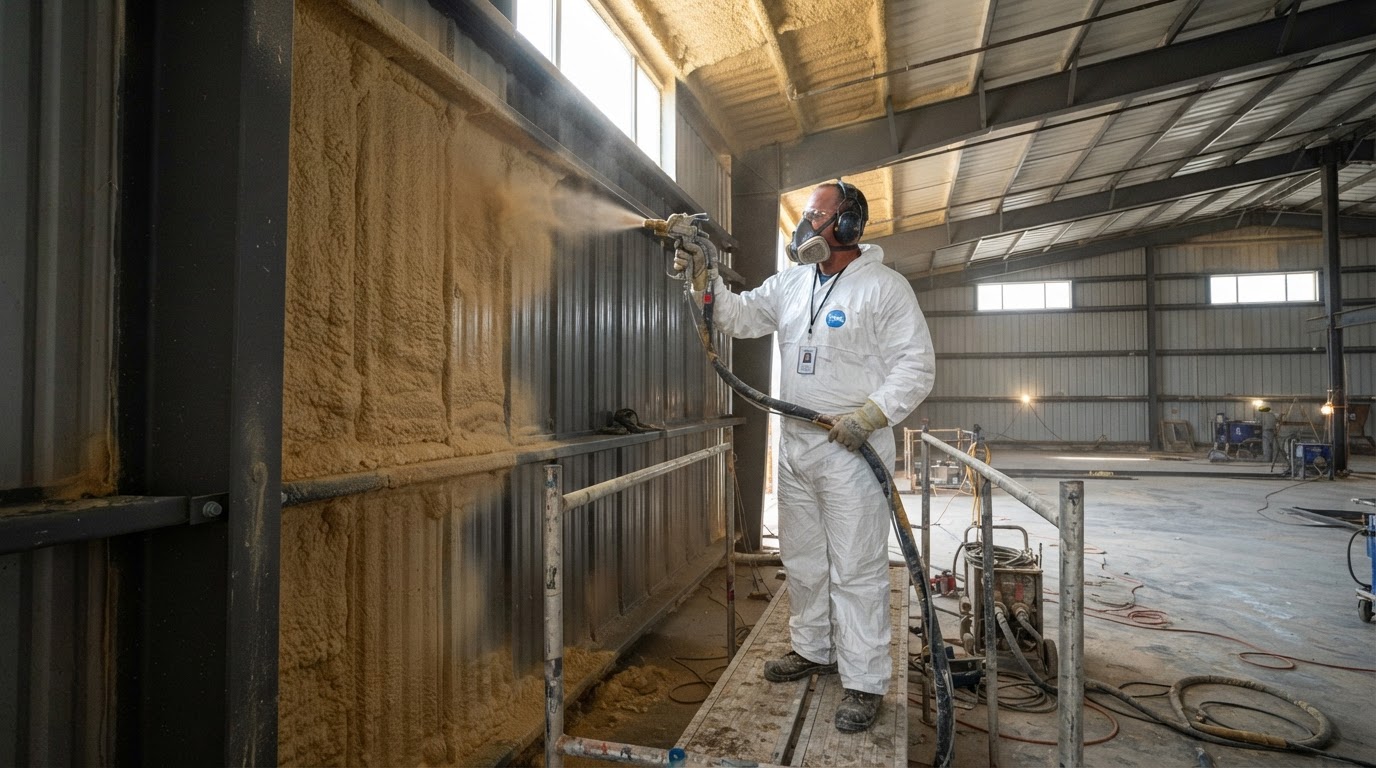
Spray foam fits a range of steel structures: steel-frame commercial buildings, steel wall and roof panel systems, steel workshops, steel storage buildings, steel warehouses, and agricultural steel buildings. The common thread is a steel substrate — structural steel framing, corrugated steel panels, or both — that the foam will bond to.
Steel is a distinct substrate. It conducts heat readily, which means steel panels can be very hot in summer and very cold in winter, creating conditions where condensation forms when warm, humid air meets the cool metal surface. Spray foam applied to the interior of steel panels can help insulate the metal and reduce the temperature differential that drives condensation.
Substrate condition and surface preparation matter. Steel panels must be reviewed for condition, fastening, and any contamination before foam is applied. A steel building with damaged panels, loose fasteners, or oily surfaces may need preparation or correction before insulation work proceeds. New steel construction allows the cleanest application before interior systems are installed.
Can spray foam be applied directly to steel panels?
Yes, when the product, substrate condition, and surface preparation are appropriate. Spray foam can bond to steel wall and roof panels to insulate and air seal the envelope. Steel should be reviewed for condition, fastening, and contamination before application, and condensation strategy and covering requirements are considered as part of the project.
Steel Building Benefits and Application Considerations
Steel buildings have specific demands around substrate, condensation, and fire protection. These are the considerations behind a steel-building spray foam project.
Steel substrate insulation
Spray foam bonds to steel panels and framing, insulating the metal skin and helping reduce the temperature swings that steel buildings experience.
Condensation strategy
Steel panels are prone to condensation. Spray foam may help, but condensation control depends on assembly design, conditions, foam selection, thickness, and moisture sources.
Surface preparation
Steel should be reviewed for condition, fastening, and contamination. Damaged panels or oily surfaces may need preparation or correction before foam is applied.
Fire-protection coverings
Depending on building use and code requirements, exposed spray foam on steel may require a thermal or ignition barrier covering. These requirements are project-specific.
Open Cell vs. Closed Cell for Steel Buildings
Steel buildings are the assembly where the open-cell versus closed-cell distinction matters most. The two products behave very differently on steel substrates.
Open-cell spray foam is a lower-density, high-expansion product. It is generally less common on bare steel panels because of its higher vapor permeability — on a condensation-prone steel surface, a more permeable foam may not provide the vapor resistance the assembly needs. It may be considered in specific framed cavities within a steel building.
Closed-cell spray foam is denser, offers a higher approximate R-value per inch, and has lower vapor permeance at appropriate product-specific thicknesses. For steel buildings, closed-cell is frequently the evaluated choice because it bonds directly to steel panels, provides a more vapor-resistant layer, and offers more thermal resistance per inch in a steel assembly where depth may be limited. It is not universally required, but it is commonly discussed for steel.
Condensation is the central technical issue. Spray foam does not automatically eliminate all condensation in a steel building. Condensation control depends on assembly design, indoor and outdoor conditions, foam selection, thickness, air leakage, and moisture sources. A steel building with high interior humidity or specific use requirements may need additional moisture management beyond insulation.
| Steel factor | Open-Cell | Closed-Cell |
|---|---|---|
| Bare steel panels | Less common | Frequently evaluated, bonds to steel |
| Vapor resistance | More permeable | Lower permeance at proper thickness |
| R-value per inch | Lower (approximate) | Higher (approximate, product-dependent) |
| Condensation strategy | Limited on bare steel | Commonly part of the strategy |
Planning a Steel Building Spray Foam Project
A steel-building project is planned around the substrate, condensation strategy, and covering requirements. These are the typical stages, though requirements vary by structure.
Discuss the steel building and use
We review whether the building is steel-frame, steel-panel, or both, its use — shop, warehouse, storage, commercial — and whether it is new or existing.
Review substrate and preparation
We look at steel panel condition, fastening, contamination, and any damage. Preparation or correction is identified before insulation work proceeds.
Determine foam, condensation strategy, and coverings
Based on the assembly and use, we discuss open-cell or closed-cell, target thickness, condensation strategy, and whether fire-protection coverings are required.
Prepare and apply
The substrate is prepared, spray polyurethane foam is applied to the steel assemblies, coverings are addressed where required, and the work area is reviewed.
Related Spray Foam Services
Huntsville Spray Foam Installation serves steel-building projects in Huntsville and across North Alabama. Call (256) 361-1406 to discuss your steel building and substrate.
Steel Building Spray Foam FAQs
Common questions about insulating steel buildings with spray foam in the Huntsville area.
Can spray foam be applied directly to steel panels?
Is closed-cell foam good for steel buildings?
Can existing steel buildings be insulated?
Does steel need special preparation before spray foam?
Can spray foam prevent condensation?
What affects steel-building spray foam pricing?
Discuss Your Steel Building Spray Foam Project
If you have a steel-frame or steel-panel building in Huntsville, Huntsville Spray Foam Installation can review the substrate, condensation strategy, and covering requirements. Call (256) 361-1406 or request an estimate to talk through your steel building.