Warehouse Spray Foam Insulation in Huntsville, AL
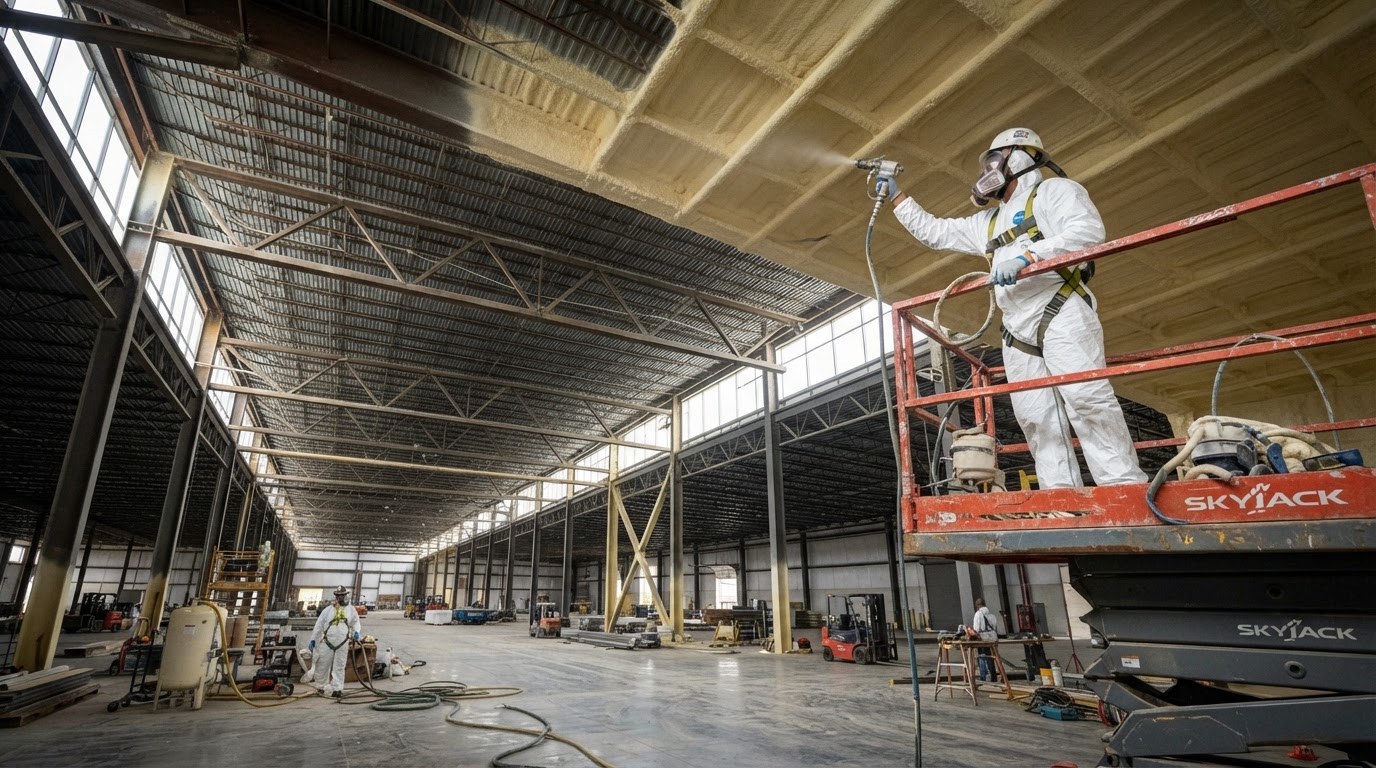
Warehouse spray foam insulation applies spray polyurethane foam to the roof and walls of a warehouse or distribution building to insulate and air seal the large envelope. For warehouse owners, managers, and builders in Huntsville, Alabama, it can help condition specific warehouse areas and reduce air leakage — but it does not solve every condensation issue, and the right approach depends on the building assembly, use, and whether the space is new or existing.
Huntsville Spray Foam Installation insulates warehouse buildings across Huntsville and North Alabama, from metal warehouses and storage-distribution spaces to new commercial construction. A warehouse is a distinct commercial envelope: large open volumes, metal or steel wall and roof assemblies, and loading-door air leakage that smaller buildings do not face. The insulation strategy follows how the space is used and conditioned.
Request an Insulation Estimate
Tell us about your warehouse spray foam insulation project.
Warehouses That Can Use Spray Foam
Spray foam fits a range of warehouse configurations: metal warehouses, storage and distribution buildings, conditioned warehouse areas within a larger facility, and new commercial warehouse construction. The common thread is a large envelope where the owner wants either full conditioning or a stable environment for stored goods, equipment, or personnel.
The value in a warehouse is air sealing at scale. Large roof and wall areas, loading-dock door gaps, and metal panel seams create significant air leakage. Spray foam conforms to the assembly and seals those gaps in one application, which is what allows a conditioning system to maintain a target environment without fighting constant infiltration.
Retrofit versus new construction is a key distinction. New warehouse construction allows spray foam to be applied before interior systems and finishes are in place. Existing warehouses may be retrofit candidates where roof and wall assemblies are accessible, though contents, operations, and occupancy can affect what is realistic during a retrofit.
Can a warehouse use spray foam insulation?
Yes. Metal warehouses, storage and distribution buildings, and conditioned warehouse areas can use spray foam to insulate and air seal the roof and walls. It helps reduce air leakage across the large envelope. The right approach depends on the assembly, use, and whether the building is new or existing.
Warehouse Insulation Benefits and Application Considerations
Warehouses are large envelopes with specific demands around conditioning, loading-door leakage, and condensation. These are the considerations behind a warehouse spray foam project.
Conditioned warehouse areas
In a heated or cooled warehouse zone, spray foam helps air seal the large envelope so the conditioning system can maintain the target environment efficiently.
Roof and wall assemblies
Warehouse roofs and walls are the primary envelope surfaces. Spray foam can be applied to suitable metal or framed assemblies to insulate and air seal them.
Loading-door air leakage
Loading docks and large doors are major leak paths. While spray foam addresses the surrounding envelope, door seals and weatherization are separate considerations.
New construction sequencing
In new warehouse construction, spray foam is scheduled after framing and rough-in and before interior finishes, so the envelope is accessible.
Open Cell vs. Closed Cell for Warehouse Assemblies
Warehouse roofs and walls are often metal, which shapes the foam choice. Open-cell and closed-cell behave differently on large metal assemblies, and neither solves every condensation issue.
Open-cell spray foam is a lower-density, high-expansion product. It is sometimes used in framed warehouse wall and roof assemblies where air sealing and cavity fill are the objectives. Its higher vapor permeability means it is generally not chosen where a vapor-resistant layer against metal is the goal.
Closed-cell spray foam is denser, offers a higher approximate R-value per inch, and has lower vapor permeance at appropriate product-specific thicknesses. For metal warehouse roofs and walls, closed-cell is frequently evaluated because it bonds to metal panels and provides a more vapor-resistant layer. It is commonly discussed for metal assemblies, but it is not universally required.
Condensation is a real concern in metal warehouses, but spray foam does not automatically eliminate all condensation. Condensation control depends on assembly design, indoor and outdoor conditions, foam selection, thickness, air leakage, and moisture sources. A warehouse with high interior humidity or specific stored-goods requirements may need additional moisture management beyond insulation.
| Warehouse factor | Open-Cell | Closed-Cell |
|---|---|---|
| Metal roof/walls | Less common on bare metal | Frequently evaluated for metal |
| R-value per inch | Lower (approximate) | Higher (approximate, product-dependent) |
| Vapor permeance | More permeable | Lower permeance at proper thickness |
| Typical use | Framed wall/roof cavities | Metal roofs, walls, vapor-sensitive areas |
Planning a Warehouse Spray Foam Project
A warehouse project is planned around the building size, the metal or framed construction, and whether the space is new or existing. These are the typical stages, though requirements vary by facility.
Discuss the facility and use
We review whether the warehouse is metal or framed, new or existing, and how the space is conditioned and used — storage, distribution, or conditioned work area.
Review the envelope and access
We look at roof and wall assemblies, metal panel condition, loading-door areas, contents, and whether operations must continue during installation.
Determine the foam and application
Based on the assembly and use, we discuss open-cell or closed-cell and the target areas — roof, walls, or specific conditioned zones.
Prepare and apply
The work area is prepared around operations where needed, spray polyurethane foam is applied to the intended assemblies, and the work area is reviewed and cleaned.
Related Spray Foam Services
Huntsville Spray Foam Installation serves warehouse projects in Huntsville and across North Alabama. Call (256) 361-1406 to discuss your warehouse envelope.
Warehouse Spray Foam FAQs for Huntsville Facilities
Common questions about insulating warehouses with spray foam in the Huntsville area.
Can a warehouse use spray foam insulation?
Is closed-cell spray foam good for a metal warehouse?
Can an existing warehouse be retrofitted?
Can spray foam be applied to warehouse roofs and walls?
Does spray foam solve every condensation issue?
What affects warehouse spray foam cost in Huntsville?
Discuss Your Warehouse Spray Foam Project
If you own, manage, or are building a warehouse in Huntsville, Huntsville Spray Foam Installation can review the envelope and discuss a suitable approach for your conditioning goals. Call (256) 361-1406 or request an estimate to talk through your warehouse project.