Air Sealing & Draft Proofing with Spray Foam in Huntsville, AL
Air sealing with spray foam is the application of spray polyurethane foam to accessible gaps, transitions, and penetrations in a building envelope to reduce uncontrolled air movement. Huntsville Spray Foam Installation identifies the leakage areas that are reachable and uses foam to seal them, while being clear that spray foam does not make a structure perfectly airtight or fix every draft source.
Uncontrolled air leakage is one of the most common comfort and performance complaints in Huntsville and North Alabama homes. Drafts at rim joists, attic boundaries, and framing transitions let humid summer air in and heated winter air out. Spray foam can help seal the accessible leaks, but it is one tool within a larger building-envelope picture that may also involve doors, windows, ventilation, and HVAC.
Request an Insulation Estimate
Tell us about your air sealing & draft proofing with spray foam project.
What Air Sealing With Spray Foam Actually Means
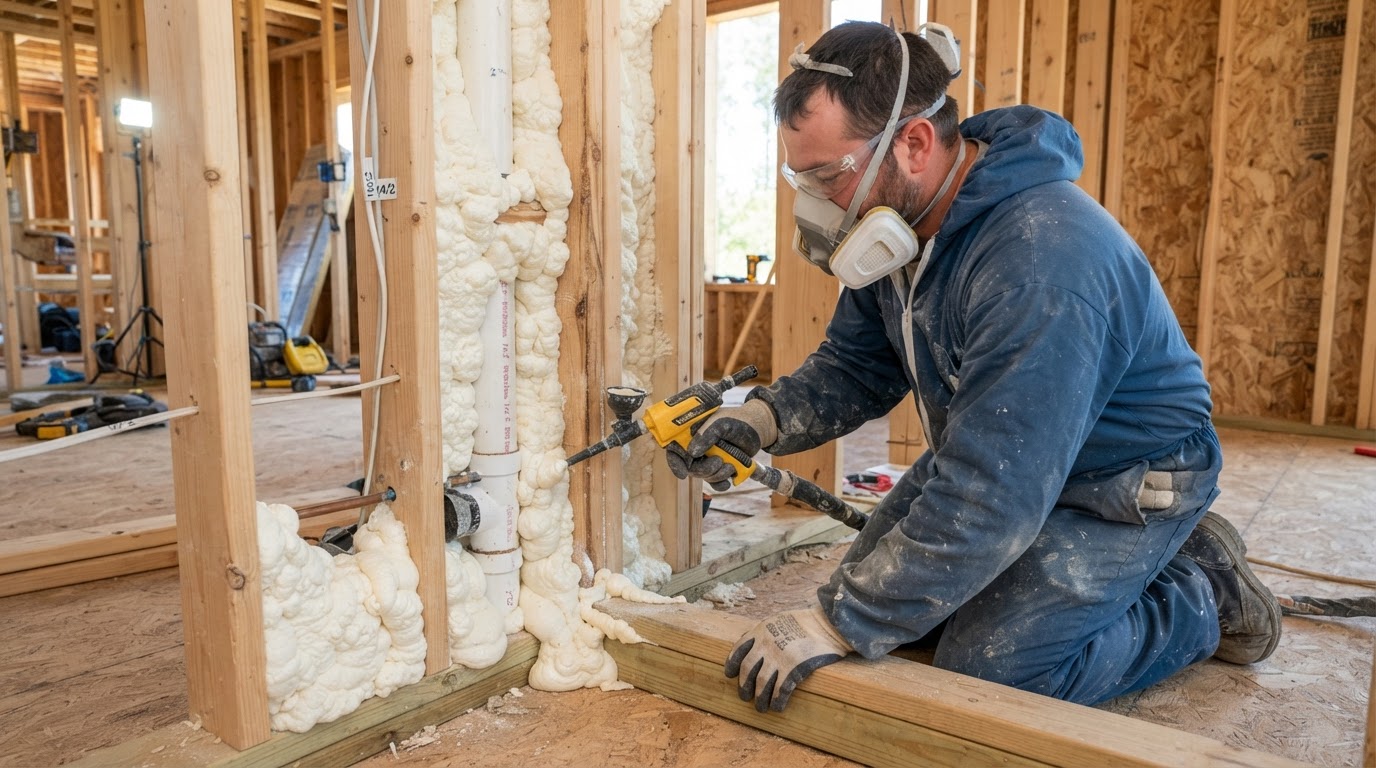
Air sealing is the practice of closing the gaps where air moves unintentionally through a building envelope. Spray polyurethane foam is well suited to this work because it expands on application and adheres to framing, sheathing, and penetrations, sealing irregular gaps that caulk and rigid materials cannot easily reach. The result is a reduction in uncontrolled air movement at the locations that are treated, not a perfectly airtight structure.
Common leakage areas include the rim and band joist at the foundation line, the attic floor boundary where wiring and plumbing penetrate from below, framing transitions between floors, plumbing and electrical penetrations through walls, and the gaps around ducts where they enter conditioned space. Each of these is a path where air moves under pressure differences created by wind, stack effect, and mechanical systems. Sealing accessible paths can reduce that movement.
It is important to be clear about what air sealing is not. Spray foam does not fix drafts caused by leaky windows, poorly weatherstripped doors, unbalanced HVAC pressure, or a lack of ventilation. Those are separate issues that may need different solutions. We focus on the accessible envelope leaks that foam can address and explain where other work may be needed.
What is air sealing?
Air sealing is closing the gaps where air moves unintentionally through a building envelope. Spray foam helps because it expands and adheres to framing and penetrations, sealing irregular gaps. Air sealing reduces uncontrolled air movement at the treated locations, but it does not make a home perfectly airtight or address drafts from windows, doors, or HVAC pressure on its own.
How Uncontrolled Air Leakage Affects a Home
Air leakage matters because it drives both comfort problems and the heating and cooling loads that follow. The effects below are the ones most often linked to accessible envelope leaks that spray foam can help address.
Comfort and temperature swings
Drafts at the rim line and attic boundary create cold spots in winter and humid infiltration in summer. Sealing accessible leaks can help rooms feel more consistent.
Heating and cooling loads
Uncontrolled air movement makes conditioning equipment work harder to maintain temperature. Reducing leakage can help lower that added load, though savings are not guaranteed.
Humidity and dust movement
Leaky envelopes pull humid outdoor air and attic dust into living space. Sealing the entry paths can help reduce how much of that moves through the building.
Envelope performance
Insulation performs best when air is not moving through it. Sealing gaps helps the insulation layer do its job rather than being bypassed by air flow.
Spray Foam and Air Sealing: How They Relate
Spray foam is both an insulation and an air-sealing material in one application, which is what makes it useful for draft proofing. The product choice and the locations treated both matter.
Both open-cell and closed-cell spray foam provide air sealing when applied at appropriate thicknesses to suitable substrates. Open-cell expands significantly and fills deep framed cavities, making it effective at sealing interior wall, ceiling, and roofline assemblies where framing is accessible. Closed-cell is denser and is frequently evaluated for rim joists, crawl spaces, and metal or foundation assemblies where lower vapor permeance and higher R-value per inch are desired.
The relationship between insulation and air sealing is that insulation resists conductive heat flow but does little to stop convective air movement through gaps. When air can bypass the insulation layer, the insulation's value is reduced. Sealing the accessible gaps with foam helps the surrounding insulation perform as intended. This is a professional contractor service, not a do-it-yourself canned-foam project; proper application requires trained installers, appropriate product, and substrate preparation.
We do not claim spray foam makes a home airtight. Every building needs some controlled ventilation for occupant health and moisture management, and tightening an envelope may require attention to ventilation strategy depending on the project. Air sealing with spray foam targets the uncontrolled leaks; it does not replace the need for intentional ventilation where required.
| Leakage area | Common foam approach | What foam does not fix |
|---|---|---|
| Rim and band joist | Closed-cell often evaluated | Window or door drafts |
| Attic floor penetrations | Foam around wiring, ducts | Unbalanced HVAC pressure |
| Framing transitions | Foam at floor and wall gaps | Lack of ventilation design |
| Plumbing and electrical | Foam at wall penetrations | Leaky duct connections |
Planning an Air Sealing Project in Huntsville
An air sealing project is built around identifying which leaks are reachable and treating those locations, rather than spraying everywhere blindly.
Identify accessible leakage areas
We review the rim joist, attic boundary, framing transitions, and accessible penetrations to determine which leaks can be reached and treated.
Determine the scope
Based on access and project goals, we define which locations will be sealed and which foam is appropriate for each assembly.
Prepare cavities and transitions
Accessible cavities and framing transitions are prepared so foam bonds to clean, suitable substrates.
Apply foam and review
Foam is applied to the targeted leakage areas, and related envelope areas are reviewed for follow-up needs such as ventilation or other trades.
Related Spray Foam Services
Huntsville Spray Foam Installation performs professional air sealing with spray foam in Huntsville and North Alabama, targeting accessible envelope leaks while being clear about where ventilation or other solutions may be needed.
Air Sealing & Draft Proofing FAQs for Huntsville Homeowners
Common questions about sealing air leaks with spray foam in the Huntsville area, with honest answers about what foam can and cannot do.
What is air sealing?
Can spray foam help reduce drafts?
Where do homes commonly leak air?
Does spray foam make a house airtight?
Can attic air leaks be sealed with spray foam?
Can rim joists contribute to drafts?
How much does professional air sealing cost in Huntsville?
Discuss Your Air Sealing & Draft Proofing Project
If drafts at the rim line, attic boundary, or framing transitions are a concern, Huntsville Spray Foam Installation can review the accessible leaks and discuss a spray foam air sealing approach. Call (256) 361-1406 or request an estimate to talk through your project.