
Basement Spray Foam Insulation in Huntsville, AL
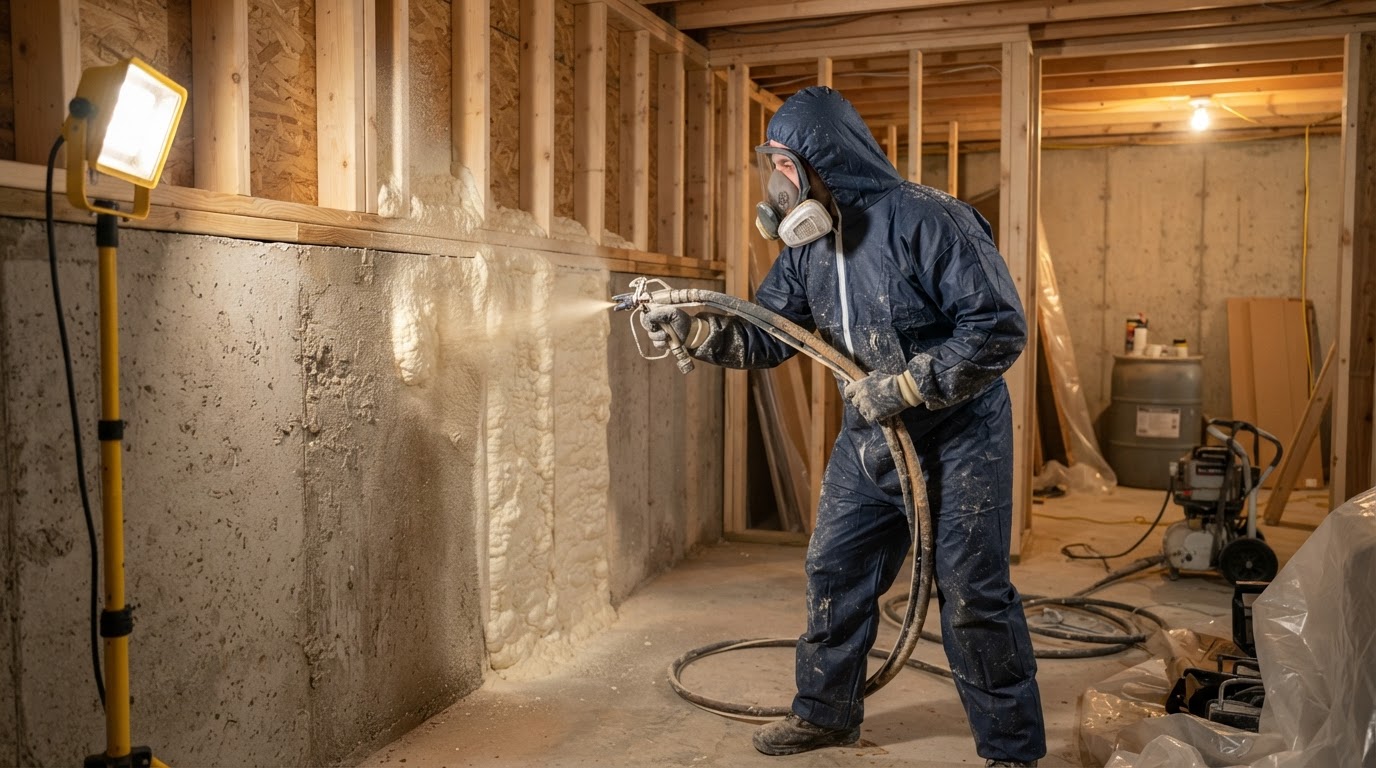
Basement spray foam insulation applies spray polyurethane foam to accessible basement wall assemblies, rim and band joist areas, and framed basement walls to insulate and air seal the lower level of a home. Huntsville Spray Foam Installation evaluates the assembly and, critically, confirms that active moisture, leakage, or drainage problems are corrected before any insulation is installed, because spray foam does not repair water intrusion.
Basements in Huntsville and North Alabama homes present a distinct set of conditions. Foundation walls stay cool year-round, rim joists leak air at the foundation-to-framing line, and humidity moves through concrete and framing if the envelope is not sealed. Spray foam can help insulate and air seal accessible basement assemblies, but only when the substrate is dry and any moisture sources have been addressed separately.
Request an Insulation Estimate
Tell us about your basement spray foam insulation project.
Basement Assemblies That Can Use Spray Foam
Basement spray foam projects generally involve a few accessible assemblies. The rim and band joist area at the top of the foundation wall is one of the leakiest transitions in a home and a frequent target for air sealing. Framed basement walls built out from the foundation can be insulated within the stud cavities. Foundation walls themselves may be evaluated for spray foam when the surface is dry, sound, and suitable for the product, though foam should not be applied to every wall automatically.
Finished basements and unfinished basements are handled differently. In an unfinished basement with open framing, the rim joist and framed walls are reachable. In a finished basement, retrofitting means the assembly must be opened to access the framing or foundation, which is a larger project. Existing insulation, mechanical runs, and plumbing and electrical all affect what is reachable.
The distinction from crawl space and rim joist pages matters here. A crawl space page focuses on the underfloor and foundation perimeter below the living space; the rim joist page focuses specifically on that band joist cavity. This page addresses the full basement environment, including foundation walls, the rim joist as part of that environment, framed walls, and basement ceiling or floor framing where relevant.
Can spray foam be used in a basement?
Yes. Spray foam can be used on accessible basement rim joists, framed basement walls, and suitable foundation wall assemblies when the substrate is dry and sound. It insulates and air seals in one application. Spray foam does not repair foundation leaks, flooding, groundwater intrusion, or active moisture, so those issues must be corrected before insulation is installed.
Why Basements Leak Air and Lose Heat
Basement comfort and performance problems usually trace back to a few envelope conditions. These are the issues a basement spray foam project is meant to address.
Cold foundation walls
Concrete foundation walls stay cool and conduct heat out of the basement. Insulating accessible wall assemblies can help stabilize surface temperature and reduce the cold-wall effect.
Rim joist air leakage
The band joist at the foundation line is a major air leak path. Sealing it with foam can help reduce drafts that enter the basement and travel up into the living space above.
Foundation-to-framing gaps
The transition between the concrete foundation and wood framing leaves gaps. Foam conforms to irregular transitions better than rigid materials to seal that boundary.
Utility penetrations
Plumbing, electrical, and duct penetrations through the basement envelope are air leakage paths. Foam seals these penetrations where they are accessible.
Open Cell vs. Closed Cell for Basement Assemblies
Basement moisture conditions make the foam choice particularly important. The two products behave differently against foundation materials, and neither is always required.
Closed-cell spray foam is frequently evaluated for basement rim joists and foundation wall assemblies because of its density, higher approximate R-value per inch, and lower vapor permeance at appropriate product-specific thicknesses. In damp-prone below-grade environments, the lower vapor permeance can be a relevant property. Closed-cell is commonly discussed for below-grade and rim applications, but it is not universally required and the substrate must be dry and sound first.
Open-cell spray foam is a lower-density, higher-expansion product. It is sometimes used in framed basement wall cavities where air sealing and cavity fill are the goals and where vapor permeability is acceptable for the assembly. Because open-cell is more vapor permeable, it is generally not the first choice where a vapor-resistant layer against a foundation wall is the objective.
Foundation wall applications require care. Spray foam should not be applied to a wall with active leaks, efflorescence from ongoing water movement, or damaged concrete or block. The assembly, climate, vapor strategy, and product specifications all affect what is appropriate. We do not imply foam belongs on every foundation wall; the condition of the wall and the moisture strategy come first.
| Basement assembly | Open-Cell | Closed-Cell |
|---|---|---|
| Rim and band joist | Sometimes used | Frequently evaluated |
| Foundation wall (dry, sound) | Generally not first choice | Often considered |
| Framed basement wall cavities | Used for air sealing/cavity fill | Used where vapor resistance desired |
| Below-grade moisture behavior | More vapor permeable | Lower permeance at proper thickness |
Planning a Basement Spray Foam Project in Huntsville
A basement project is moisture-first: we confirm the substrate is dry and any water or drainage issues are resolved before any insulation is installed.
Review moisture sources
We look for active leaks, seepage, drainage problems, or damaged materials. Any moisture source must be corrected before insulation is installed, since spray foam does not repair water intrusion.
Confirm access and substrate
We confirm which assemblies are reachable, the condition of foundation walls and framing, and whether the space is finished or unfinished.
Determine the foam and assembly approach
Based on the assembly, we discuss open-cell or closed-cell for rim joists, framed walls, and any suitable foundation wall areas.
Prepare and apply
The work area is prepared, foam is applied to the intended assemblies, and the work area is reviewed and cleaned.
Related Spray Foam Services
Huntsville Spray Foam Installation evaluates basement assemblies in Huntsville and North Alabama on a project-by-project basis, confirming dry, sound substrates before any spray foam application.
Basement Spray Foam FAQs for Huntsville Homeowners
Common questions about insulating basements with spray foam in the Huntsville area, including the honest limits around moisture.
Can spray foam be used in a basement?
Can basement walls be insulated with spray foam?
Can rim joists in a basement be spray foamed?
Does spray foam stop basement water leaks?
Open-cell or closed-cell for a basement?
Can an existing finished basement be retrofitted?
What affects basement spray foam cost in Huntsville?
Discuss Your Basement Spray Foam Project
If you are planning basement insulation for rim joists, framed walls, or foundation assemblies, Huntsville Spray Foam Installation can review the substrate and discuss a suitable approach. Call (256) 361-1406 or request an estimate to talk through your basement project.