
Spray Foam Insulation for Sound Reduction in Huntsville, AL
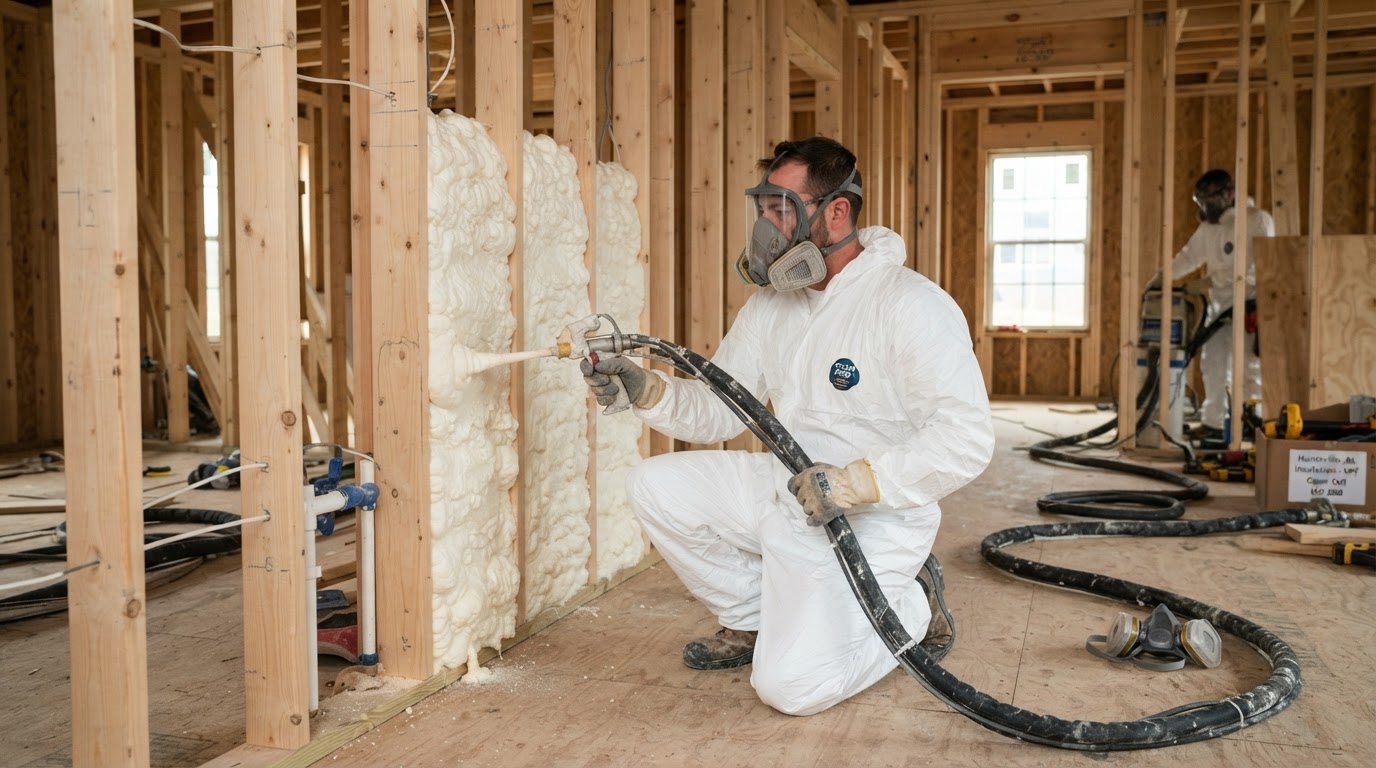
Spray foam insulation can help reduce some airborne sound transmission in suitable wall and ceiling cavities, but insulation alone generally does not create a completely soundproof room. Huntsville Spray Foam Installation uses open-cell foam in accessible interior assemblies to help with sound attenuation, while being clear that true soundproofing usually requires mass, decoupling, and sealing that go beyond insulation alone.
Homeowners in Huntsville and North Alabama often ask about spray foam for sound control in interior walls, bedrooms, home offices, media rooms, and workshops adjacent to living areas. The honest framing matters: spray foam can help reduce airborne sound, but it is not a complete soundproofing solution on its own. Sound control is a system, and foam is one part of it.
Request an Insulation Estimate
Tell us about your soundproofing spray foam insulation project.
Spray Foam for Sound Reduction, Not Complete Soundproofing
The phrase 'soundproofing spray foam' is common in search, but it is technically imprecise. What spray foam can do is sound attenuation, meaning a reduction in some airborne sound transmission through a wall or ceiling cavity. What it generally cannot do is create a completely soundproof room that blocks all noise. The difference matters because it sets realistic expectations for what insulation alone can achieve.
Open-cell spray foam is often considered for sound attenuation in appropriate interior cavities because of its cellular structure, which can absorb some airborne sound. It is used in interior walls between bedrooms and living areas, around home offices and media rooms, and in ceiling cavities where reducing sound transfer between floors is the goal. Closed-cell can also reduce sound transmission but is denser and is less commonly chosen purely for acoustics.
We do not give fake STC ratings or invent laboratory performance numbers. Sound transmission performance depends on the full assembly, not the foam alone. We describe what foam can realistically contribute within a wall or ceiling cavity and where other elements are needed for meaningful sound control.
Does spray foam soundproof a room?
No, not completely. Spray foam can help reduce some airborne sound transmission in suitable wall and ceiling cavities, but insulation alone generally does not create a completely soundproof room. True soundproofing usually requires mass, decoupling, and sealing that go beyond insulation. Foam is one part of a sound control system, not a complete solution on its own.
What Affects Sound Transmission Through a Wall
Sound control is about the whole assembly. These are the factors that determine how much sound moves through a wall or ceiling, and where spray foam fits in.
Air gaps and sealing
Unsealed gaps let sound through freely. Foam seals cracks and penetrations, which is one of the most useful acoustic contributions it makes.
Mass and decoupling
Heavier assemblies and decoupled framing reduce sound transmission more than insulation alone. Foam does not add much mass and does not decouple framing.
Doors, windows, and ducts
Sound flanks around a wall through hollow doors, single-pane windows, and unlined ducts. Foam in the wall cavity does not address these paths.
Flanking paths
Sound travels through floors, ceilings, and shared framing. A wall assembly is only as quiet as its weakest flanking path.
Open Cell, Closed Cell, and Sound Attenuation
The foam choice for sound reduction is different from the choice for thermal performance. Here is how the two products relate to acoustics.
Open-cell spray foam is the product most often considered for sound attenuation because its softer, more open cellular structure can absorb some airborne sound within a cavity. It is commonly used in interior partition walls, ceilings between floors, and around media rooms or home offices where reducing airborne sound transfer is the goal. Its acoustic contribution comes from cavity fill and air sealing, not from mass.
Closed-cell spray foam is denser and rigid. It can reduce some sound transmission but is less commonly chosen purely for acoustics because its rigid structure transmits vibration more readily than open-cell. Closed-cell is typically selected when thermal performance or vapor resistance is the primary driver and sound reduction is secondary.
We do not claim one foam product eliminates traffic, machinery, music, or other noise, and we do not invent STC ratings. Meaningful sound control usually combines sealed cavities with appropriate mass, resilient channels or decoupling where needed, solid doors, and attention to flanking paths. Foam plays a real but limited role within that system.
| Acoustic factor | Open-Cell | Closed-Cell |
|---|---|---|
| Cavity absorption | Often considered for sound | Less common for acoustics |
| Structure | Softer, more open cells | Dense and rigid |
| Air sealing | Seals gaps and penetrations | Seals gaps and penetrations |
| Primary use for sound | Interior walls and ceilings | Usually secondary benefit |
Planning a Sound Reduction Project in Huntsville
A sound reduction project starts with understanding the noise path and defining what role insulation can realistically play in the assembly.
Identify the noise path
We discuss what sound is the concern, where it travels, and whether it is airborne or structure-borne, which shapes what foam can address.
Inspect the open cavity
Where framing is exposed, we review the wall or ceiling cavity and the penetrations that contribute to sound flanking.
Define the insulation role
We set realistic expectations for what foam can do within the cavity and where mass, decoupling, or solid doors may also be needed.
Select foam and coordinate
Open-cell is typically selected for sound attenuation, applied to the accessible cavity, and we coordinate notes on other sound-control elements.
Related Spray Foam Services
Huntsville Spray Foam Installation provides spray foam for sound reduction in Huntsville and North Alabama, with honest expectations about what insulation can and cannot do for acoustics.
Spray Foam for Sound Reduction FAQs
Common questions about using spray foam for sound reduction in the Huntsville area, with honest answers about the limits.
Does spray foam soundproof a room?
Can open-cell spray foam help reduce sound?
Is spray foam good for interior walls?
Can spray foam reduce workshop noise?
What is the difference between soundproofing and sound attenuation?
Is closed-cell or open-cell better for sound reduction?
How much does spray foam for sound reduction cost?
Discuss Your Sound Reduction Project
If you want to reduce airborne sound between rooms, around a home office, or in a workshop, Huntsville Spray Foam Installation can review the accessible cavity and discuss what foam can realistically do. Call (256) 361-1406 or request an estimate to talk through your project.