Tiny Home Spray Foam Insulation in Huntsville, AL
Tiny home spray foam insulation applies spray polyurethane foam to the limited-depth walls, roof, and floor assemblies of a small home where space efficiency and air sealing matter. Huntsville Spray Foam Installation insulates tiny homes in Huntsville and North Alabama, while being clear that a tightly insulated small envelope often needs appropriate ventilation and that spray foam does not make a tiny home compliant with residential code.
Tiny homes in Huntsville and North Alabama present a distinct insulation problem. The wall and roof cavities are shallow, the interior volume is small, and the thermal and air barrier has to do a lot of work in a thin layer. Spray foam is often considered for tiny homes because of its air sealing and high R-value per inch, but the small interior volume makes ventilation an important part of the conversation.
Request an Insulation Estimate
Tell us about your tiny home spray foam insulation project.
What Makes a Tiny Home Envelope Different
A tiny home has limited wall cavity depth, small roof assemblies, and a compact interior volume. The shallow framing means the total R-value achievable is constrained by cavity depth, so high-performance-per-inch products are valuable. The small interior volume means that air sealing has an outsized effect: a tight tiny home can hold humidity and indoor pollutants if ventilation is not part of the plan.
Tiny home assemblies include walls, the roof or loft, and often the floor. Each has its own depth and moisture considerations. Trailer or mobile foundations, where relevant, add a floor assembly that may be over an open or semi-open base. Mechanical ventilation in a small, tight envelope matters more than in a larger home, because there is less interior air volume to buffer.
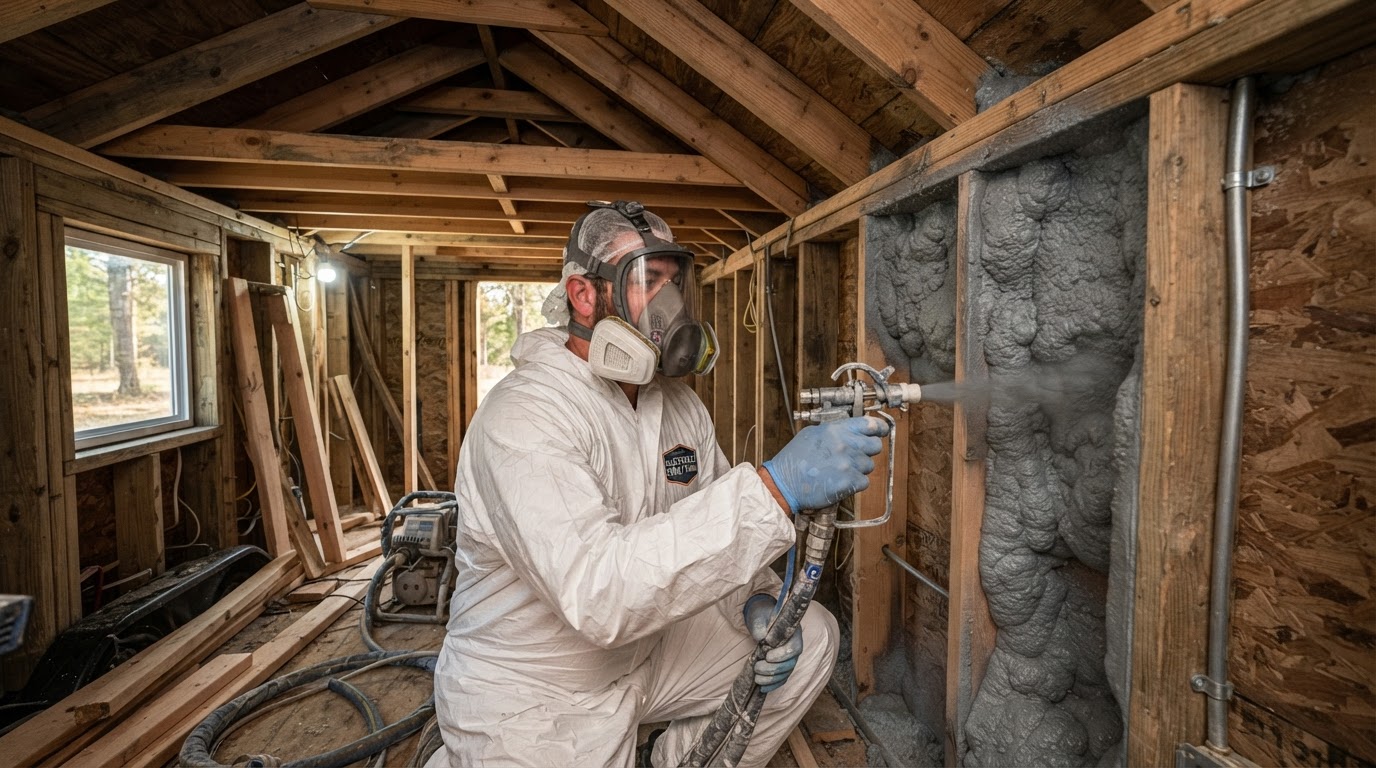
New construction sequencing is the easiest situation. When the tiny home is being built and framing is exposed, spray foam can be applied to the walls, roof, and floor before interior finishes go in. Retrofitting a finished tiny home is more difficult because the compact assembly is harder to open and access.
Is spray foam good for a tiny home?
Yes. Spray foam is often considered for tiny homes because it air seals and provides high R-value per inch in shallow wall, roof, and floor cavities. Because tiny homes have small interior volumes, a tight envelope often needs appropriate ventilation. Spray foam does not make a tiny home compliant with residential code; legality and occupancy depend on jurisdiction and design.
Tiny Home Benefits and Building Considerations
The compact nature of a tiny home shapes both the benefits and the cautions of spray foam. These are the considerations behind a tiny home project.
Continuous air sealing
Foam seals the small envelope in one application, which is valuable where every gap matters in a compact structure.
Limited framing depth
Shallow walls and roofs constrain total R-value. Foam's high performance per inch helps where depth is limited.
Penetrations and loft
Loft and roof penetrations in a tiny home are air leakage paths. Foam seals these where accessible before finishes.
Ventilation matters
A tight small envelope can hold humidity and pollutants. Tighter building envelopes often need appropriate ventilation strategy.
Open Cell vs. Closed Cell for Tiny Homes
The foam choice for a tiny home depends on available cavity depth and whether vapor resistance or permeability fits the assembly.
Closed-cell spray foam is often considered for tiny homes because of its higher R-value per inch, which is valuable where wall and roof depth is very limited. Its lower vapor permeance at appropriate product-specific thicknesses can be relevant for floor assemblies over a trailer base or for roof assemblies. Closed-cell can achieve more thermal resistance in less thickness, which matters in a compact structure.
Open-cell spray foam is a lower-density, higher-expansion product. It can be considered for framed wall and roof cavities where depth allows and where vapor permeability is acceptable for the assembly. Its higher expansion helps fill cavities, but it requires more depth to reach the same R-value as closed-cell.
Because tiny homes have small interior volumes, we do not imply that airtight is always better. A tight envelope often needs appropriate ventilation strategy to manage humidity and indoor air quality. The foam choice is balanced against the assembly depth, moisture strategy, and the ventilation plan. We do not prescribe one universal choice for every tiny home.
| Tiny home factor | Open-Cell | Closed-Cell |
|---|---|---|
| R-value per inch | Lower (product-dependent) | Higher (product-dependent) |
| Cavity depth needed | More depth for same R | Less depth for same R |
| Floor over trailer base | Less common | Often considered |
| Vapor behavior | More permeable | Lower permeance at proper thickness |
Planning a Tiny Home Spray Foam Project in Huntsville
A tiny home project is planned around the shallow assemblies, mechanical coordination, and ventilation, with foam applied before interior finishes.
Review assembly depth
We look at wall, roof, and floor cavity depth to determine what R-value is achievable and which foam fits the limited framing.
Coordinate mechanical systems
We coordinate with electrical, plumbing, and any mechanical ventilation so foam is applied at the right stage before finishes.
Consider ventilation
Because a tight small envelope can hold humidity, we discuss that appropriate ventilation strategy may be needed for the tiny home.
Select foam and apply before finishes
Open-cell or closed-cell is selected based on the assembly, and foam is applied before interior finishes are installed.
Related Spray Foam Services
Huntsville Spray Foam Installation insulates tiny homes in Huntsville and North Alabama, with attention to compact assembly depth and the ventilation needs of a tight small envelope.
Tiny Home Spray Foam FAQs
Common questions about insulating tiny homes with spray foam in the Huntsville area.
Is spray foam good for a tiny home?
Open-cell or closed-cell for a tiny house?
Can tiny-home walls be spray foamed?
Can the roof of a tiny home use spray foam?
Does a tightly insulated tiny home need ventilation?
Can a tiny home be spray foamed before interior finishes?
What affects tiny-home spray foam pricing?
Discuss Your Tiny Home Spray Foam Project
If you are building or insulating a tiny home, Huntsville Spray Foam Installation can review the compact assemblies and discuss a suitable approach with ventilation in mind. Call (256) 361-1406 or request an estimate to talk through your tiny home project.