Cabin & Hunting Cabin Spray Foam Insulation Near Huntsville, AL
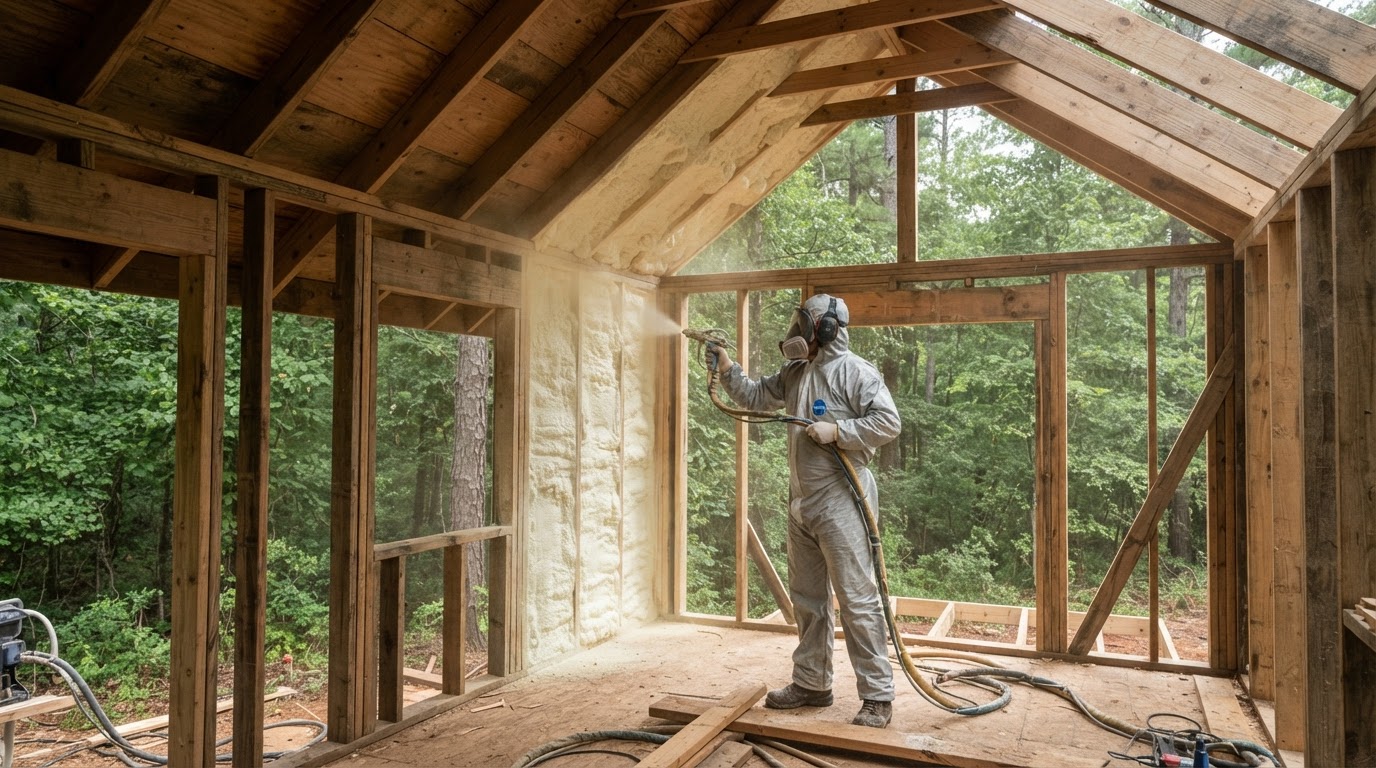
Cabin and hunting cabin spray foam insulation applies spray polyurethane foam to the walls, roof, and floor assemblies of small recreational and seasonal-use cabins near Huntsville and across North Alabama. Huntsville Spray Foam Installation insulates framed cabins, metal-roof cabins, and hunting cabins for intermittent conditioning, while being clear that spray foam does not guarantee freeze protection for plumbing or automatically keep pests out.
Cabins and hunting cabins in the North Alabama and Tennessee Valley region are often used seasonally or on weekends, which creates a different insulation conversation than a full-time home. The roof, walls, and floor all need to perform when the building is heated or cooled intermittently, and the assembly strategy depends on the construction type and how the cabin is used. Spray foam can help, with some honest limits.
Request an Insulation Estimate
Tell us about your cabin & hunting cabin spray foam insulation project.
What Makes Cabin Insulation Different
Cabins and hunting cabins are usually smaller, often used seasonally or on weekends, and sometimes located in remote or rural settings. That intermittent use means the building may be heated or cooled only when occupied, so the insulation has to help the space reach comfort quickly and hold it during use. Framed cabins, metal-roof cabins, and small hunting cabins each have their own assembly considerations.
The roof and ceiling assembly matters because cabin roofs are often simple and exposed, with limited attic space. Wall cavities depend on the framing, whether it is standard dimensional lumber or a simpler post-and-girt structure. Floor assemblies matter in cabins built on piers or skids where the floor is over open air. New construction is the easiest time to insulate; existing cabins can sometimes be retrofitted where assemblies are accessible.
The distinction from tiny home and residential pages matters here. A tiny home is a compact, often mobile, year-round-capable structure with ventilation as a key concern. A residential page covers full-time homes. This page focuses on seasonal and recreational cabins, including hunting cabins, where intermittent conditioning and remote locations shape the insulation plan.
Can a hunting cabin be insulated with spray foam?
Yes. Framed cabins, metal-roof cabins, and hunting cabins can be insulated with spray foam on walls, roofs, and floors when the assembly is suitable. Spray foam helps air seal the cabin envelope for intermittent conditioning, but it does not guarantee freeze protection for plumbing or automatically keep pests out. The approach depends on the construction type and how the cabin is used.
Cabin Insulation Problems and Considerations
Seasonal use and remote locations create a specific set of insulation considerations for cabins near Huntsville.
Intermittent conditioning
Cabins heated or cooled only when occupied need an envelope that reaches comfort quickly. Air sealing helps reduce the load during use.
Roofline and walls
Cabin roofs and walls are often simple assemblies. Foam can insulate and air seal the roofline and wall cavities where accessible.
Floor assemblies
Cabins on piers or skids have floors over open air. Floor insulation and air sealing help where the assembly allows access.
Existing cabin access
Retrofitting an existing cabin depends on which assemblies are reachable. New construction is the easiest time to insulate.
Open Cell vs. Closed Cell for Cabins
The foam choice for a cabin depends on the assembly, available cavity depth, roof configuration, wall construction, and the moisture strategy for how the cabin is used.
Open-cell spray foam is a lower-density, higher-expansion product. It can be considered for framed cabin wall and roof cavities where air sealing and cavity fill are the goals and where vapor permeability fits the assembly. Its higher expansion helps fill cavities in standard framing. Open-cell is sometimes chosen for interior cabin assemblies where drying inward is acceptable.
Closed-cell spray foam is denser and offers a higher approximate R-value per inch, which is useful where cabin framing is shallow. Its lower vapor permeance at appropriate product-specific thicknesses can be relevant for floor assemblies over open air or for metal-roof cabins where condensation is a concern. Closed-cell is often considered for cabin floors and metal roof assemblies.
We do not say one product is universally correct for cabins. The choice depends on the assembly, available cavity depth, roof configuration, wall construction, moisture strategy, and building use. A framed cabin with standard wall depth may suit open-cell, while a shallow-floor or metal-roof cabin may lean toward closed-cell. Each cabin is evaluated for its specific construction.
| Cabin factor | Open-Cell | Closed-Cell |
|---|---|---|
| Framed wall cavities | Often considered | Used where vapor resistance desired |
| Shallow framing | Needs more depth for R | Higher R per inch helps |
| Floor over open air | Less common | Often considered |
| Metal roof cabin | Less common on metal | Often considered for metal |
Planning a Cabin Spray Foam Project Near Huntsville
A cabin project is planned around the construction type, the seasonal use, and which assemblies are reachable, whether new construction or retrofit.
Discuss seasonal use
We review whether the cabin is used seasonally, on weekends, or more continuously, since that shapes the conditioning and insulation strategy.
Review construction type
We look at whether the cabin is framed, has a metal roof, and how the floor is built, which affects which foam and assemblies fit.
Determine the product approach
Based on the assembly, depth, roof, and floor, we discuss open-cell or closed-cell for walls, roof, and floor as appropriate.
Prepare and apply
Accessible assemblies are prepared and spray polyurethane foam is applied, with the work area reviewed and cleaned.
Related Spray Foam Services
Huntsville Spray Foam Installation insulates cabins and hunting cabins near Huntsville and across North Alabama, with an approach tailored to seasonal use and the specific cabin construction.
Cabin & Hunting Cabin Spray Foam FAQs
Common questions about insulating cabins and hunting cabins with spray foam near Huntsville, with honest limits around pests and freeze protection.
Can a hunting cabin be insulated with spray foam?
Is spray foam good for a seasonal cabin?
Can an existing cabin be retrofitted?
Can spray foam be used under a cabin roof?
Open-cell or closed-cell for a cabin?
Does spray foam keep pests out of a hunting cabin?
What affects cabin spray foam cost near Huntsville?
Discuss Your Cabin Spray Foam Project
If you are insulating a framed cabin, hunting cabin, or seasonal recreational structure, Huntsville Spray Foam Installation can review the construction and discuss a suitable approach. Call (256) 361-1406 or request an estimate to talk through your cabin project.